How College Students in India Can Build an AI Portfolio in 30 Days
Employers now ask freshers for proof, not just degrees. A 30-day plan for Indian students in any stream to build an AI portfolio recruiters notice.

Vivek Gupta · IIT Delhi alumnus
· 5 min read

Most students I meet have the same plan for AI: add "ChatGPT" to the skills section of their CV and hope it helps. It rarely does. A recruiter reading fifty CVs a day can't tell your "ChatGPT" from anyone else's.
What they can tell apart is proof. A small project that solved a real problem, with a before-and-after number, says more than any line on a CV. The good news is that you can build one in a month, in any stream, without writing code.
What employers are actually asking freshers for
The shift is visible in the hiring data. TeamLease EdTech's Career Outlook Report for January to June 2026 found that nearly 73% of employers in India plan to hire freshers, and that companies are moving away from judging candidates on degrees alone. Recruiters want proof of work: internships, real projects, and visible participation in professional communities (The Tribune, February 2026). As TeamLease EdTech's chief executive put it, the real divide is between candidates who can demonstrate applied skills and those who cannot.
LinkedIn's Skills on the Rise 2026 list for India points the same way. AI and automation is the first of its five fastest-growing skill stacks, and the skills it names, like prompt engineering and workflow automation, are ones you can learn without a computer science degree. The same report found that 38% of Indian job seekers feel unprepared for how fast required skills are changing (Storyboard18, February 2026).
That 38% is your opening. If most of your batch feels unprepared, a student with one finished AI project already stands out.
The 30-day plan
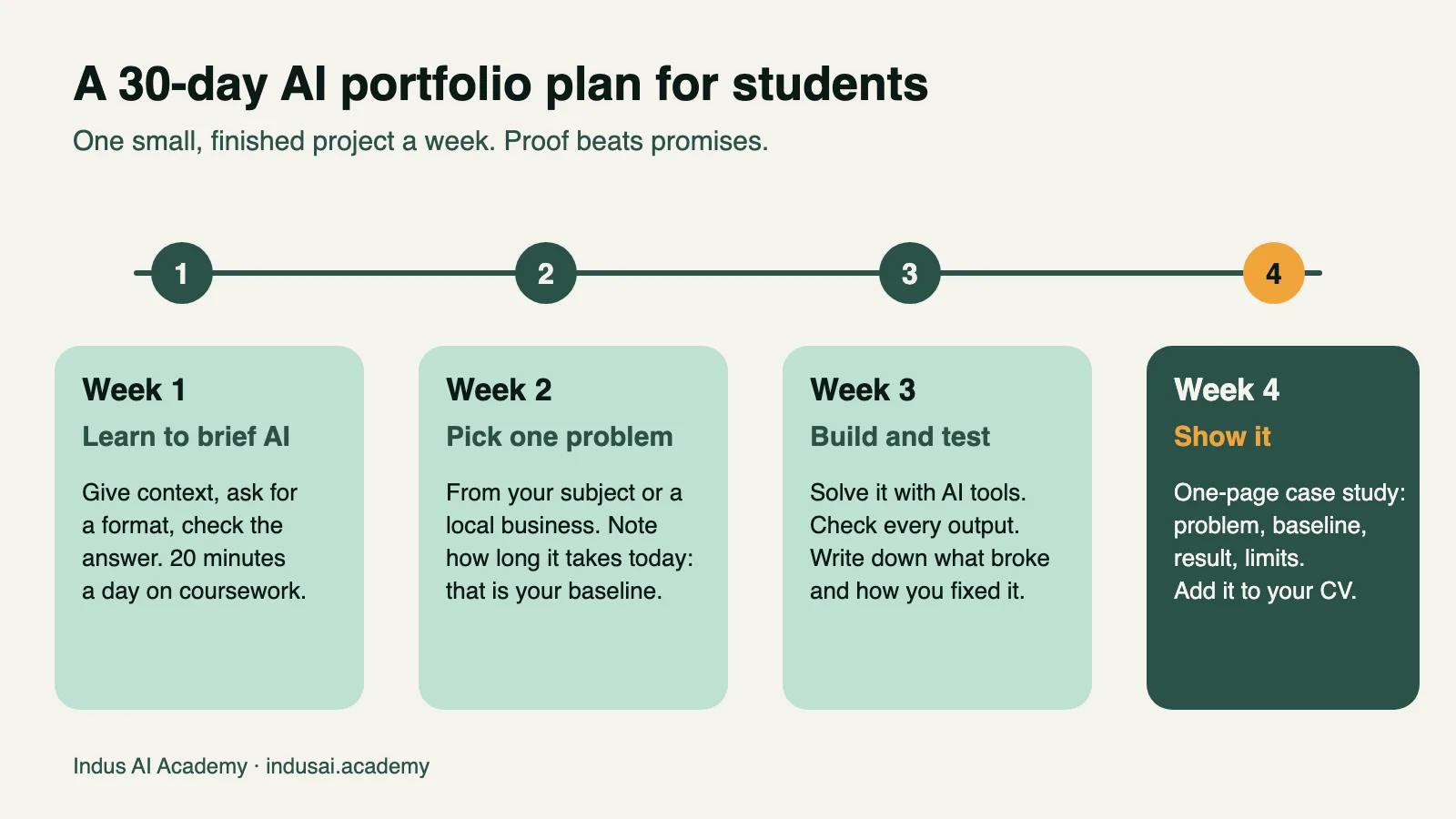
Week 1: learn to brief AI properly
Spend 20 minutes a day using an AI assistant on your actual coursework: summarising a chapter, turning notes into a quiz, explaining a concept two ways. The free tier of any major assistant is enough for practice.
The skill you're building isn't "using ChatGPT". It's briefing: telling the tool who you are, what you need, in what format, and then checking the answer. Notice where it gets things wrong. That habit of checking is what employers mean when they say they want people who use AI responsibly.
Week 2: pick one real problem
Choose something small, concrete and yours. Some examples by stream:
| Your stream | A project you could finish in two weeks |
|---|---|
| Commerce or BBA | Turn a month of a local shop's sales notes into a simple weekly summary and reorder list |
| Engineering | Build a study assistant that turns lecture notes into practice questions for your batch |
| Arts or humanities | Create a bilingual (English and Hindi or your language) explainer series on a topic you know well |
| Science | Summarise and compare five research papers in your field into one clear brief |
| Any stream | Automate the replies and reminders for a college club or event |
Before you start, write down how long the task takes today. That number is your baseline, and it's what makes your project believable.
Week 3: build it and test it
Solve the problem with AI tools. Keep a short log as you go: what you asked, what came back, what was wrong, what you changed. Check every output a person will rely on.
This log matters more than you think. In an interview, "here is where the AI got it wrong and how I caught it" is a far stronger answer than "it worked perfectly".
Week 4: show it
Write a one-page case study:
- The problem, in one or two sentences.
- The baseline: how long or how hard it was before.
- What you built, with one or two screenshots.
- The result: time saved, errors caught, or people helped.
- The limits: what still needs a human, and why.
Put it on your LinkedIn profile as a project or post, link it from your CV, and be ready to walk through it in five minutes.
Mistakes that make student AI projects forgettable
- Listing tools instead of results. "Used ChatGPT, Gemini and Canva" tells a recruiter nothing. "Cut a club's weekly reminder work from two hours to twenty minutes" does.
- Projects with no real user. A project someone actually used, even five classmates, beats an impressive demo nobody touched.
- Hiding the failures. Honest limits show judgement, which is exactly what employers are screening for.
- Starting five projects and finishing none. One finished project is worth more than any number of half-built ones.
Want to go further, with structure and feedback?
A self-run month gets you one project. What it rarely gets you is feedback from someone who builds AI systems for a living, a deadline that keeps you going, and a portfolio of work that covers more than one kind of problem.
That's what our AI Generalist Certification is built for. It's beginner-friendly with no coding required: 12 live evening sessions over four weeks (Tuesdays, Thursdays and Saturdays, 7 to 9 PM IST), where you build automations, agents and small AI apps on real tasks, get feedback on your own work, and finish with a certificate backed by assessed projects that anyone can verify online. Seats are open for the next cohort.
Start this week
You don't need permission, a perfect idea or a coding background to begin. Pick the smallest real problem you can find, write down how long it takes today, and spend this week learning to brief an AI tool properly. In a month you'll have something most of your batch won't: proof.
If you'd like to build that portfolio alongside other learners, with live guidance, take a look at the AI Generalist Certification and join the next cohort.
Found this useful?
Next cohort starts 1 Dec
AI Generalist Certification
Become the person on your team who gets things done with AI.
- Tuesdays, Thursdays and Saturdays, 7–9 PM IST
- 4 weeks · 12 sessions · 24 live hours · Online
- For: Professionals, managers, founders and career switchers
- ₹24,999 per seat, taxes extra
About the author
Vivek Gupta · IIT Delhi alumnus
Vivek Gupta is an IIT Delhi alumnus and PhD scholar, an AI researcher and serial entrepreneur with 14 years of building technology at MakeMyTrip, Goibibo, Wissen and Jubilant FoodWorks.
Discussion
No comments yet. Start the discussion.