How Duolingo Uses AI: A Real Case Study in Building With It
Inside Duolingo's AI tutor, its video-call avatar and the machine learning behind lessons for 50 million daily users, plus what its AI rollout got wrong.

Vivek Gupta · IIT Delhi alumnus
· 11 min read

Duolingo is one of the few consumer products in the world where you can actually see how AI changed the business, because the company has been unusually open about it — in engineering posts, in SEC filings, and, less comfortably, in a CEO memo that triggered a public backlash. That combination makes it a rare thing: an AI case study you can check against primary sources instead of a press release.
This article walks through what Duolingo actually built, what it actually measured, and what went wrong when it talked about AI and jobs in the same breath. If you're trying to understand how AI gets built into a real product — or trying to learn AI yourself — there's more to learn from Duolingo's mistakes than from its highlight reel.
Key takeaways
- Duolingo runs two different kinds of AI, years apart in maturity: an in-house machine learning model (Birdbrain) that has personalized lessons since 2020, and large language model (LLM) features (Duolingo Max) that arrived with GPT-4 in 2023.
- The AI tutor features are built from careful prompt engineering and review, not a single magic model call: separate steps handle setup, conversation, mid-call correction and memory.
- The company reports real financial results tied to AI investment: Q3 2025 revenue grew 41% year over year to $271.7 million, even as generative AI costs measurably cut into gross margin.
- Its biggest AI misstep was communication, not technology. An April 2025 "AI-first" memo was read as a layoff announcement, and the CEO later admitted he hadn't given employees enough context.
- None of this came from one big model. Every result here came from narrow, measured bets that started small and expanded only after testing.
What Duolingo actually built
Duolingo's best-known AI work falls into two categories that are easy to confuse but work very differently.
The first is Duolingo Max, a premium subscription tier launched in March 2023, the same day OpenAI released GPT-4. It added two GPT-4-powered features: "Explain My Answer," which lets a learner ask why a response was right or wrong, and "Roleplay," a chatbot that holds a scripted conversation, like ordering coffee in Paris, then gives feedback on accuracy and complexity. Duolingo picked GPT-4 because it was, in the company's words, "the most accurate (and fastest) version of the technology available," and the team spent months testing with staff and a small group of users before launch, according to TechCrunch's report on the launch. Crucially, the roleplay scenarios themselves — the setting, the opening line, where the conversation is allowed to go — are written by humans. The model fills in the conversation; it doesn't design the lesson.
The second, deeper feature is Video Call with Lily, an AI character learners can have a live spoken conversation with, launched in 2024 and expanded through 2025. According to Duolingo's own engineering blog post on the feature, the team spent roughly a year "iterating and tweaking" before shipping it, specifically on guardrails, because unlike a scripted roleplay, a live conversation is a situation the company doesn't fully control.
The third, and in some ways the most important, is Birdbrain: the machine learning system that decides which exercises you see and when, running quietly behind every lesson since 2020. It has nothing to do with GPT-4 or chatbots, and most users never hear its name.
Inside the AI tutor: how the conversation actually stays on track
The mechanics behind Video Call with Lily are a useful worked example of what "building with AI" looks like in practice, because the system is not one model call but a small pipeline:
- System prompt. A detailed instruction set defines Lily's personality (described as sarcastic and introverted), her backstory, the learner's level (mapped to the CEFR scale used for language proficiency), and rules for what to do if the learner gets stuck or goes off-topic.
- Conversation prep. A separate step generates the opening question before the call starts, tailored to the learner's level and the call's stated purpose — telling a story, asking an opinion, or just chatting.
- The live loop. As the learner speaks, a mid-call evaluation step checks their last message and can adjust Lily's reply, for example reacting to something the learner mentioned or slowing down if they seem confused.
- A fixed closer. The call doesn't run indefinitely. After a set number of exchanges, Lily ends it, which also gives learners a reason to come back for the next one.
- Memory, scoped tightly. After the call, a separate model reads the transcript and extracts facts worth remembering, which get added to a list tied to that learner's account only. Duolingo's AI lead has said the company doesn't train a model on this data.
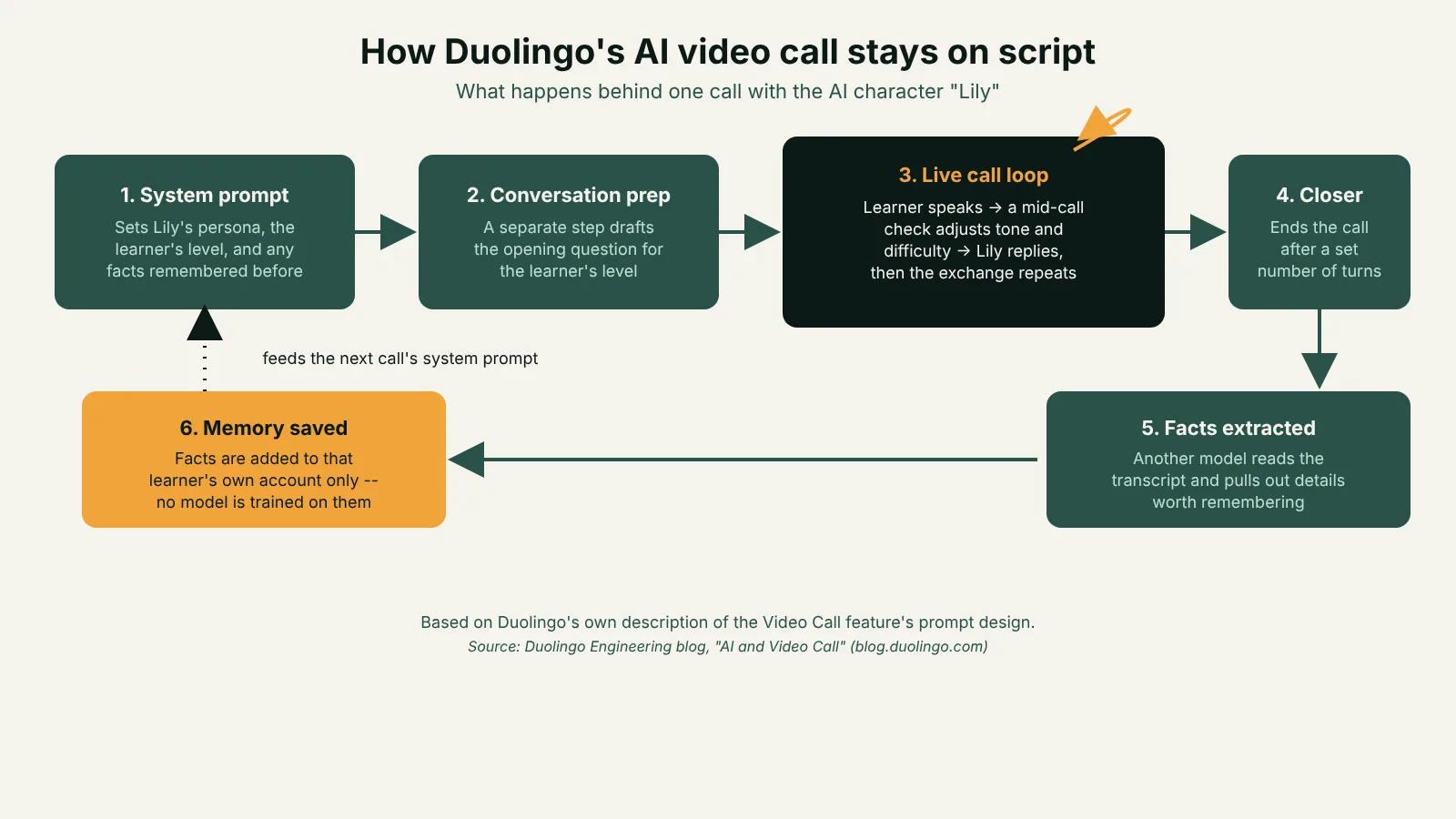
Notice what isn't in that list: nothing here is a single, unconstrained chatbot. Every stage is a narrower, more checkable task than "have a conversation," which is exactly the kind of decomposition that separates working AI products from demos. It's the same idea covered in more general terms in our guide to AI agents for business: break a broad task into steps you can test individually, and keep a human- or rule-based check between steps that matter.
The personalization engine most users never notice
If Video Call with Lily is the visible AI, Birdbrain is the invisible one, and it's arguably done more for Duolingo's business. According to IEEE Spectrum's technical account of the system and Duolingo's own introduction of Birdbrain, it has gone through two very different versions:
- Birdbrain V1 (2020) used logistic regression inspired by item response theory, a statistical method originally built for standardized testing. It estimated exercise difficulty by summing up the difficulty of its component features (exercise type, specific vocabulary) and updated its estimate of a learner's ability after every single exercise, in a way the engineers compare to a generalized Elo rating system — the same style of rating used in chess.
- Birdbrain V2 replaced that with a long short-term memory (LSTM) neural network that compresses a learner's entire interaction history into a 40-number vector representing their ability. Because that's a vector and not a single score, the model can tell the difference between, say, strong vocabulary but weak past tense, rather than reducing a learner to one number.
The engineering story matters as much as the model choice. New versions of Birdbrain first run in "shadow mode" — making predictions without acting on them — before any A/B test decides whether they actually ship. Duolingo reported that lessons built around Birdbrain's difficulty predictions "consistently helped our learners learn more" and increased the odds they'd return the next day. At Duolingo's scale — more than 50 million active learners completing roughly one billion exercises a day, per IEEE Spectrum — even a small, measured improvement in exercise selection compounds into a large effect on retention.
What the AI investment actually delivered — and cost
Here is where Duolingo's disclosure as a public company is useful: you don't have to take a vendor's word for the payoff. The company's Q3 2025 shareholder letter, filed with the U.S. Securities and Exchange Commission, reported:
| Metric (Q3 2025) | Value | Year-over-year change |
|---|---|---|
| Revenue | $271.7 million | +41% |
| Daily active users (DAU) | 50.5 million | +36% |
| Monthly active users (MAU) | 135.3 million | +20% |
| Paid subscribers | 11.5 million | +34% |
| Gross margin | 72.5% | -0.4 points, attributed to AI and hosting costs |
CEO Luis von Ahn described the company's "increasing conviction that AI can fundamentally change what's possible in how we teach." But the same letter is explicit that generative AI isn't free: rising model and hosting costs were the stated reason gross margin slipped, even as the company said its full-year cost outlook had actually improved slightly on "lower-than-expected AI costs." That's a more honest picture than most AI case studies offer — growth and cost pressure in the same document, not just the upside.
The "AI-first" memo: where the real lesson is
In April 2025, von Ahn sent an all-staff memo describing Duolingo as moving to an "AI-first" company and saying it would "gradually stop using contractors to do work that AI can handle." He posted it on LinkedIn. The backlash was fast and loud: users and employees read it as a mass-layoff signal, and some learners publicly pledged to quit the app, as reporting at the time described.
What makes this worth studying isn't the backlash itself — plenty of companies get an angry social media reaction — but how specific and avoidable the mistake was. Within days, von Ahn clarified: "I do not see AI as replacing what our employees do." Months later, in an August 2025 interview reported by Fortune, he went further: "This was on me. I did not give enough context." He maintained that Duolingo has never laid off full-time employees and has no plans to, and that only "a very small number" of contractors doing repetitive work were phased out, some moved to other roles. The company's contractor numbers, he said, "have gone up and down depending on needs" for years, independent of AI.
Strip away the controversy and the underlying message was actually reasonable: AI should let existing employees do more, not necessarily mean fewer employees. That's close to what NASSCOM and multiple large IT employers have also reported in India — productivity gains redeployed rather than headcount simply cut. The failure was in the delivery: a memo that used "AI-first" and "stop using contractors" in the same paragraph, with no acknowledgment of how that would read to anyone already anxious about AI and jobs.
A simple checklist before you copy any of this
Before borrowing Duolingo's playbook for your own product, team or workflow, it's worth asking the same questions its own case shows the value of:
- Can you test it before you commit to it? Birdbrain ships through shadow mode and A/B tests first; nothing goes live on a hunch.
- Is a human checking the output somewhere that matters? Roleplay scenarios are human-written; Explain My Answer collects thumbs-up or thumbs-down feedback after every response.
- What does it cost at your actual scale? Duolingo's own numbers show generative AI costs measurably moving gross margin, not just engineering time.
- Who does the task today, and have you told them anything yet? The costliest mistake here wasn't a model choice — it was announcing a strategy before explaining what it meant for the people already doing the work.
- Does the feature decompose into smaller, checkable steps? The video call pipeline — prep, live loop, closer, memory — is simpler to debug and improve than one unconstrained model call would be.
Frequently asked questions
What AI technology does Duolingo use?
Duolingo uses two different kinds of AI. Its personalization engine, Birdbrain, is an in-house machine learning model (a neural network in its current version) that predicts exercise difficulty and has run since 2020. Its learner-facing chat and conversation features, under the Duolingo Max tier, use large language models, starting with GPT-4 in 2023.
Did Duolingo replace workers with AI?
According to CEO Luis von Ahn, Duolingo has not laid off any full-time employees for AI reasons and has no plans to. A 2025 memo about becoming "AI-first" and reducing contractor use for repetitive tasks was widely read as a layoff signal, which von Ahn later said was a communication failure on his part, not an accurate description of the company's plans for its staff.
How does the Duolingo AI video call with Lily actually work?
It runs as a short pipeline rather than one open-ended chatbot call: a system prompt sets Lily's persona and the learner's level, a separate step drafts the opening question, a mid-call check adjusts tone and difficulty as the conversation happens, a fixed closer ends the call after a set number of exchanges, and a final step extracts facts from the transcript to remember for next time.
What results has Duolingo reported from its AI investment?
In its Q3 2025 shareholder letter, Duolingo reported revenue of $271.7 million (up 41% year over year), 50.5 million daily active users (up 36%), and 11.5 million paid subscribers (up 34%), while also reporting that generative AI and hosting costs reduced gross margin by about 0.4 percentage points.
Can a small team apply Duolingo's AI approach without its budget?
Yes, the pattern matters more than the scale. Pick one narrow, measurable task (not "add AI to the product"), test it quietly before turning it on for everyone, keep a human checkpoint where mistakes are costly, and communicate any change to the people doing the work before you announce it publicly.
How to go deeper
Reading one company's case study tells you what's possible. Building the underlying skills — breaking a task into stages an AI can actually do reliably, writing prompts that behave consistently, evaluating output before you trust it — is what makes you able to design something like this yourself, for your own work. Our guide to what an AI generalist actually does covers that skill set in more detail.
The Indus AI Academy AI Generalist Certification builds exactly this: a live, cohort-based program where you practice prompting, context handling, and building small AI workflows and agents, with feedback on your own work from instructors rather than a self-paced video course. You finish with a reviewed capstone project and a certificate anyone can verify, and the next cohort is open for enrollment now.
If Duolingo's story leaves you with one thing, let it be this: none of what it built started as a finished product. Every feature here — the tutor, the video call, the personalization engine — started as a small, measured bet that was allowed to fail quietly before it was allowed to scale loudly.
Sources used in this article: TechCrunch on the Duolingo Max launch, Duolingo's engineering blog on AI and Video Call, Duolingo's introduction of Birdbrain, IEEE Spectrum's technical account of Birdbrain, Duolingo's Q3 2025 SEC shareholder letter, Entrepreneur's report on the April 2025 memo and backlash, and Fortune's report on von Ahn's August 2025 clarification.
Found this useful?
Next cohort starts 1 Dec
AI Generalist Certification
Become the person on your team who gets things done with AI.
- Tuesdays, Thursdays and Saturdays, 7–9 PM IST
- 4 weeks · 12 sessions · 24 live hours · Online
- For: Professionals, managers, founders and career switchers
- ₹24,999 per seat, taxes extra
About the author
Vivek Gupta · IIT Delhi alumnus
Vivek Gupta is an IIT Delhi alumnus and PhD scholar, an AI researcher and serial entrepreneur with 14 years of building technology at MakeMyTrip, Goibibo, Wissen and Jubilant FoodWorks.
Discussion
No comments yet. Start the discussion.