How AI Is Helping Stop Illegal Logging in Rainforests
How an engineer turned old phones into solar-powered AI that catches illegal logging in real time, and what AI for rainforest conservation can teach you.

Vivek Gupta · IIT Delhi alumnus
· 11 min read
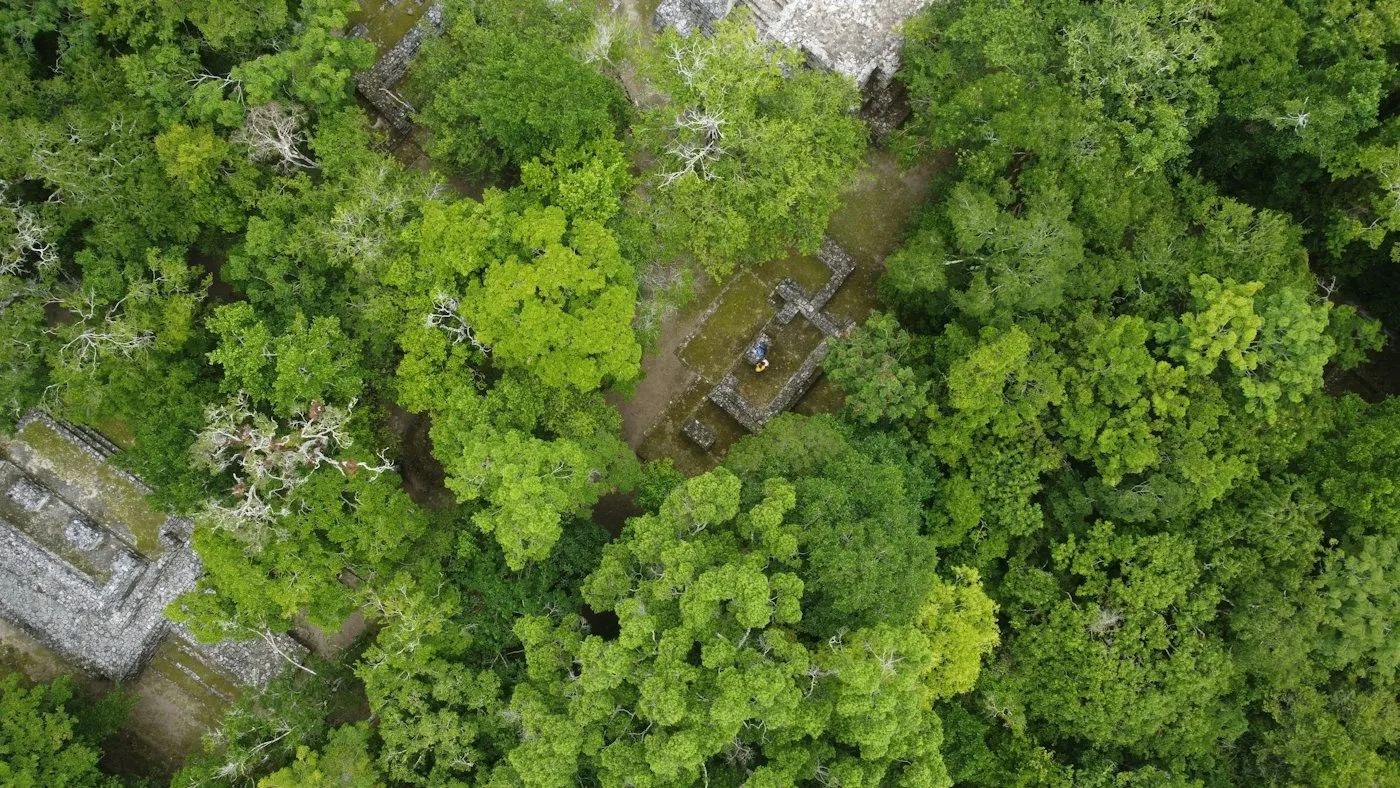
In a rainforest, you can't see more than 20 feet in front of you. But you can hear a kilometer away. That one fact is the entire idea behind one of the more useful applications of AI for rainforest conservation working today: an old cell phone, bolted to a tree and listening around the clock, can hear a chainsaw start up long before a ranger on foot ever would.
The organization that built this, Rainforest Connection (RFCx), now runs listening devices across dozens of countries, on every forested continent. It started in 2013 with a volunteer at a gibbon sanctuary in Borneo, a pile of secondhand Android phones, and a frustrated question: why does it take so long to notice a chainsaw in a protected forest?
Key takeaways
- Sound travels where sight can't. Rainforest Connection's "Guardian" devices use solar-powered microphones placed high in the canopy to catch chainsaws, logging trucks and gunshots from up to 1,500 meters away, even where dense trees make visual patrols nearly useless.
- It started as a hack, not a company. Founder Topher White built the first version from Android phones bought on eBay for under $5 each, after a sanctuary director's frustration over logging a few hundred meters from a ranger station.
- The AI does one narrow job well. A model trained on labeled audio clips tells a chainsaw apart from rain, birdsong and wind, then triggers a real-time alert — it doesn't decide what happens next; a human ranger does.
- The organization reports it has helped protect over 700,000 hectares of forest and now runs in dozens of countries, though these are self-reported figures, not independently audited results.
- It is honest about its limits. Deterrence, not arrests, is the realistic goal, and partners on the ground have said logging sometimes simply moves to an unmonitored area nearby.
The problem AI had to solve: illegal logging you can't see until it's gone
Most tools used to fight illegal logging work after the damage is done. Satellites can show a bare patch of ground where a forest used to be, but by the time that image is captured, the trees are already cut. According to the UN, as cited on Rainforest Connection's own site, up to 90% of logging in tropical rainforests is illegal. A 2015 Indonesian government report found that 30% of the country's timber industry came from illegal sources.
This isn't only a local problem. Illegally logged wood regularly enters international supply chains. In 2016, the United States fined the flooring company Lumber Liquidators $13 million over flooring made from wood illegally harvested in protected Russian forests and processed in China, as reported in the same National Geographic account of the industry's scale. Once a tree is cut, it's extremely difficult to prove where the wood actually came from.
Rangers, meanwhile, often have to cover thousands of acres with almost no way of knowing where to look. Visual patrols are slow, and in dense forest, a logging crew working a few hundred meters off a trail can go completely unnoticed. What was missing wasn't more satellite coverage — it was something that could notice a threat the moment it started, cheaply enough to put one on every hillside that mattered.
From a gibbon sanctuary to a global network
Before any of this, Topher White was an engineer who had managed a website for a nuclear fusion lab in France. In 2011, a childhood fascination with gibbons led him to volunteer at a sanctuary on Borneo, where half the island's natural vegetation had already been cleared over the previous four decades, as he recounted on the National Geographic Overheard podcast.
While there, a logging site was discovered just a few hundred meters from the ranger station — close enough that the sanctuary's director was visibly furious someone could log a protected reserve almost within earshot of the guards. White started asking an obvious question: how do you detect logging without patrolling the entire forest on foot?
Over dinner, he and the sanctuary's director worked through four or five ideas before settling on one: listen to the forest itself. The region, it turned out, already had cell phone coverage before it had roads or electricity, which meant an alert really could reach someone's phone in time to act.
White didn't know how to detect a chainsaw by sound, so he flew to the Cornell Lab of Ornithology, where researcher Yu Shiu taught him the basics of acoustic classification — recognizing a signal inside what otherwise sounds like a chaotic wall of noise. The first working devices went into a Sumatran forest in 2013, built from Android phones that cost under $5 used on eBay at the time, given solar panels and a stronger microphone. One of the first units detected a chainsaw; rangers moved in and found loggers working just over the reserve's boundary. That success turned into a crowdfunding campaign, and the crowdfunding campaign turned into a company.
How the AI actually listens for a chainsaw
The underlying idea hasn't changed since 2013, even though the hardware has moved far beyond recycled phones. Today's device, called the Guardian 3, uses three sensitive microphones that pick up sound from 50 to 1,500 meters away depending on the source, powered by solar panels adapted to catch light that filters through the canopy, according to RFCx's Guardian product page.
What happens next is a straightforward machine learning problem, even if the engineering to run it reliably in a rainforest is not: a model is trained on many labeled clips of sound — "chainsaw" versus "everything else" — and learns to tell the two apart. RFCx has published part of its own training data as the RFCx Chainsaw Audio dataset on Hugging Face, made up of three-second clips, each labeled 0 for "chainsaw present" or 1 for "environment." That's the same binary classification pattern you'd use to detect spam email or flag a defective part on a factory line — the technique transfers far beyond rainforests.
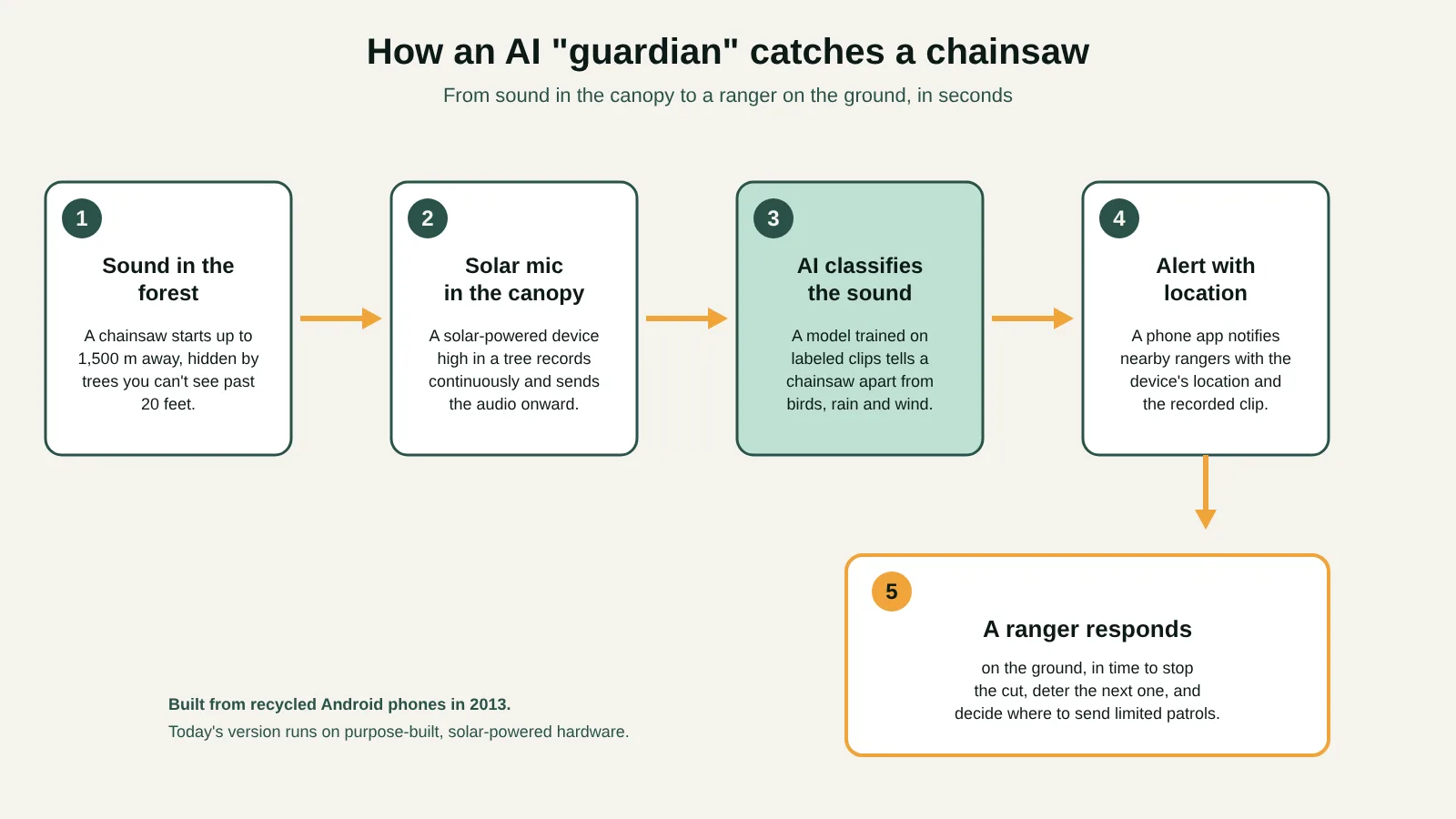
Once the model flags a threat — a chainsaw, a vehicle engine, hunting dogs or gunshots — the device sends an alert through a mobile app, including the device's location and the recorded clip, so a nearby ranger can listen in and decide how to respond. RFCx's own materials describe this pipeline in three steps: detect threats in real time, alert the nearest people with location and audio, and let a human intervene before serious damage is done. Notice what the AI is not asked to do: it never decides whether to send rangers, make an arrest, or escalate. It narrows an impossible task — listen to an entire forest, all the time — down to one a person can actually act on.
What the numbers say, and what they don't
RFCx reports some genuinely large numbers on its own site, though it's worth being clear these are the organization's self-reported figures rather than independently audited results.
| What's reported | Figure | Source |
|---|---|---|
| Rainforest protected | 726,000+ hectares | rfcx.org |
| Conservation projects worldwide | 8,662+ | rfcx.org |
| Species identified and monitored | 7,025, including 310 threatened species | rfcx.org |
| Guardian microphone range | 50–1,500 meters, depending on the sound | rfcx.org/guardian |
The devices are now deployed well beyond that first Sumatran forest: West Sumatra in Indonesia, Colombia, Poland's Białowieża forest (one of Europe's last primeval forests), and the Tembé Indigenous Reserves in Brazil, where Indigenous rangers use the alerts to defend ancestral land, per RFCx's own project listings. A pilot in Africa monitored a single road used by poachers and found that related activity was higher after dark and on weekends — giving partners a way to focus limited patrol hours on the times that actually mattered, rather than patrolling around the clock.
The honest limits of this kind of AI
None of this makes the problem solved, and RFCx's own partners are candid about why. In the Tembé reserve, Rainforest Connection's Pedro Rosa has said loggers have moved out of monitored areas after Guardians went in — which sounds like a win, until you remember that deforestation can simply shift to wherever the monitoring isn't. Acoustic monitoring changes where and when illegal activity happens; it doesn't make the underlying economic pressure to log disappear.
There's a second limit worth naming plainly: a detection system only matters where laws get enforced and someone can act on an alert quickly. A chainsaw alert reaching a ranger with no fuel for their vehicle, or in a country with no real penalty for illegal logging, accomplishes far less than the same alert in a well-resourced reserve. RFCx has said it is collecting data in Indonesia, Peru and Romania toward a formal evaluation of how much logging the system actually prevents, but we did not find a published, independently peer-reviewed study confirming its real-world deterrence rate — so treat the protected-hectares figures as the organization's own claim, not a verified outcome.
This is the same honesty worth bringing to any AI system, in conservation or at work: know what it's actually measuring, and don't mistake "we deployed it" for "it worked."
A story about skills you can actually learn
What makes this story worth telling on a Friday isn't just that it's a clever use of AI — it's that almost none of the underlying skills are exotic. Turning a stream of sound into a yes/no prediction is a well-understood audio classification problem: convert the waveform into a spectrogram or similar feature representation, then train a classifier to separate the signal you care about (a chainsaw) from everything else (wind, rain, birds, insects). It's conceptually close to how we explain building a small AI tool from scratch in another article on this blog — different data, same instinct: find the narrow, well-defined task inside a big, messy problem, and let the model do that one thing well.
If this story has you curious enough to try something similar yourself, here's a realistic starting checklist:
- Start with an open dataset, not a blank page. RFCx has published its chainsaw-detection training clips on Hugging Face — real-world audio you can experiment with, not a toy example.
- Pick one narrow signal to detect first. "Is there a chainsaw in this clip?" is learnable. "Monitor the whole forest for anything wrong" is not — notice that's exactly the same narrowing RFCx itself did.
- Expect to spend more time on data than on the model. Labeling, cleaning and splitting audio clips is most of the real work in a project like this, not picking an algorithm.
- Keep a human in the loop for anything consequential. RFCx's AI flags a threat; a ranger decides what to do about it. That division of labor is worth copying in almost any AI system you build.
- Look for projects already doing this, the way the Masakhane community built open-source AI for African languages that nobody else was funding — conservation AI has a similar open, collaborative culture you can join rather than starting alone.
How to go deeper
Reading about one organization's AI system is a good start, but the skills behind it — framing a messy real-world problem as something a model can actually learn, working with real data instead of toy examples, and knowing where a human needs to stay in the loop — are the same skills that apply whether you're trying to automate a report at work or build something like a Guardian device yourself. Our guide on what an AI generalist actually does breaks down that skill set in more detail.
The Indus AI Academy AI Generalist Certification is a live, cohort-based program built around exactly this kind of practice: you work with real data and real tools, get feedback on your own project from instructors instead of grading yourself against a video course, and finish with a capstone project and a certificate anyone can verify. The next cohort is open for enrollment now.
Illegal logging didn't get easier to stop because someone invented a dramatically new kind of AI. It got harder to get away with because one engineer decomposed an impossible problem — watch an entire rainforest, all the time — into something a $5 phone and a simple model could actually do. That pattern repeats more often than the headlines suggest, in projects far smaller than a rainforest.
Frequently asked questions
What is Rainforest Connection and how does its AI work?
Rainforest Connection (RFCx) is a conservation technology organization that places solar-powered listening devices, called Guardians, high in forest canopies. The devices record ambient sound continuously, and a machine learning model classifies that sound to detect threats such as chainsaws, logging trucks, gunshots and hunting dogs, then sends a real-time alert with location and audio to a ranger's phone.
Can AI actually stop illegal logging, or does it just detect it?
The AI itself only detects and alerts; it doesn't act. Stopping logging still depends on a ranger or authority responding to the alert, and on local laws being enforced. Partners working with the system have reported that logging sometimes simply relocates to an area that isn't monitored, so detection changes where illegal activity happens more reliably than it eliminates the underlying pressure to log.
What was the original Guardian device made from?
The first Guardian devices, built in 2013, were made from secondhand Android smartphones bought for under $5 each, fitted with a solar panel for power and an external microphone for better range. Current Guardian devices use purpose-built hardware instead of recycled phones, but the core idea, listen continuously and classify the sound, is unchanged.
Is this kind of AI used for anything besides stopping logging?
Yes. The same acoustic monitoring network is also used for biodiversity tracking: RFCx reports identifying and monitoring thousands of species, including hundreds of threatened ones, by recognizing animal calls in the same audio streams collected to catch chainsaws and gunshots.
Can I try building something like this myself?
Yes. RFCx has published a labeled dataset of chainsaw and environmental sound clips on Hugging Face that you can use to practice audio classification, the same type of machine learning problem behind the Guardian system. It's a realistic way to practice framing a messy, real-world signal as something a model can actually learn, which is a transferable skill well beyond conservation work.
Sources used in this article: Rainforest Connection's organization page, RFCx's Guardian product page, National Geographic's Overheard podcast article on Topher White's origin story, the RFCx Chainsaw Audio dataset on Hugging Face, and Topher White's TEDxCERN talk, "What can save the rainforest? Your used cell phone".
Found this useful?
Next cohort starts 1 Dec
AI Generalist Certification
Become the person on your team who gets things done with AI.
- Tuesdays, Thursdays and Saturdays, 7–9 PM IST
- 4 weeks · 12 sessions · 24 live hours · Online
- For: Professionals, managers, founders and career switchers
- ₹24,999 per seat, taxes extra
About the author
Vivek Gupta · IIT Delhi alumnus
Vivek Gupta is an IIT Delhi alumnus and PhD scholar, an AI researcher and serial entrepreneur with 14 years of building technology at MakeMyTrip, Goibibo, Wissen and Jubilant FoodWorks.
Discussion
No comments yet. Start the discussion.