How to Contribute to Open-Source AI Projects: The Masakhane Story
A practical guide to contributing to open-source AI, built from Masakhane's story: volunteers who turned into AI researchers for 2,000+ African languages.

Vivek Gupta · IIT Delhi alumnus
· 11 min read

If you want to know how to contribute to open-source AI projects, the honest answer is: find one whose mission you actually care about, and start with something small enough to finish this week. That sounds almost too simple to be useful, but it is exactly how a volunteer research community called Masakhane went from about 60 people trading messages after a conference in 2019 to a 1,000-plus-person network that has published peer-reviewed AI research for more than 30 African languages, with no gatekeeping on who gets to take part.
Masakhane's story is a useful case study for anyone outside the big AI labs who wants to do real, credited work in AI, not just watch it happen. Most of its contributors were not machine-learning PhDs when they joined; many still aren't. What they had was a problem worth solving, a community willing to teach each other, and a habit of shipping small, real work instead of waiting to feel qualified.
Key takeaways
- Masakhane started as about 60 volunteers in 2019 and has grown into a community of more than 1,000 participants across 30-plus African countries, per its own published numbers (Masakhane, VentureBeat, 2019).
- No machine-learning background is required to start. The community explicitly teaches newcomers through open meetings, shared notebooks and mentorship, not entrance exams.
- Small, real contributions compound. The group's datasets and models for named entity recognition and translation now cover 20 to 38-plus African languages, built one annotated sentence and one pull request at a time.
- Grassroots work can earn institutional backing. In January 2026, the Masakhane Hub opened a funded call to extend this work to 50 languages, backed by Google.org, the Gates Foundation and others, after a 2025 pilot drew 93 applications from 22 countries.
- The same playbook works for any open-source AI project, not just this one: join, listen, pick one small task, submit it, take feedback, repeat.
What problem Masakhane set out to fix
Africa has more than 2,000 languages, spoken by well over a billion people. Almost none of them show up in the datasets that train today's AI models. A 2020 workshop paper from the community, presented at the AfricaNLP workshop at ICLR, laid out why: a lack of government and research funding for African-language technology, poor discoverability of what little work existed, no shared benchmarks to compare techniques, and, underneath all of that, no community pulling the work together (Masakhane, "Machine Translation for Africa," arXiv, 2020).
That gap is not a small inconvenience. It means a farmer in rural Malawi, a nurse in Kinshasa or a student in Lagos is far less likely to get a useful answer from an AI system in their own language than someone writing in English or French. It also means the people who understand these languages best, native speakers without machine-learning training, had no obvious way to help fix it.
Masakhane (a word that roughly translates to "we build together" in isiZulu) was founded in 2019 by Jade Abbott and Laura Martinus, two South Africa-based practitioners, after conversations at the Deep Learning Indaba and the Sauti Yetu NLP unconference. Within months, researchers such as Kathleen Siminyu in Kenya, Olabiyi Samuel working on Yoruba in Nigeria, and Espoir Murhabazi working on Lingala in the Democratic Republic of Congo had joined, and the group had grown to around 60 contributors across South Africa, Kenya and Nigeria by late 2019 (VentureBeat, November 2019).
How an open, leaderless research project actually works
What makes Masakhane worth studying isn't just what it built. It's how ordinary people, scattered across a continent with no shared employer or funding body, organized themselves to do credible research.
The community describes itself as "a grassroots NLP community for Africa, by Africans," and its stated values are ownership, openness, reproducibility and participation by people from many disciplines, not only computer science. It explicitly rejects what it calls "parachute research," where outsiders extract data or credit from a community without involving it in the work (Masakhane).
In practice, that means:
- Weekly open meetings. Anyone can join a call, ask questions and meet collaborators, coordinated through a public mailing list and chat group with no application process.
- Shared notebooks, not locked-down codebases. New contributors work from Colab notebooks that walk through training a translation model step by step, lowering the barrier for someone's very first attempt.
- Mentorship instead of a hiring bar. Experienced members mentor newcomers directly. The entry requirement is following a code of conduct, not holding a particular degree.
- Publishing as a side effect of doing the work. Contributors who help build a dataset or evaluate a model end up as co-authors on papers presented at venues such as ACL, EMNLP and COLING, because the work itself is the qualification.
This is also why native-speaker involvement matters here. As linguist Kola Tubosun told the Associated Press, raising money for this kind of language work remains difficult, so much of it runs on volunteers who understand both the language and the cost of being excluded from the data that AI runs on (AP/PBS NewsHour, December 2021). The same article describes volunteers in Rwanda recording Kinyarwanda speech because, as organizer Remy Muhire put it, "they are native speakers, they understand the language" — work no outside contractor could do as well.
What the volunteers actually built
The results are concrete and checkable, which is part of what makes this more than a feel-good story.
The original Masakhane machine translation effort, described in the 2020 paper, produced benchmark translation results for more than 30 African languages, with human evaluation for a third of them, built through the community's participatory process rather than a single funded lab (arXiv 2003.11529). MasakhaNER, published in 2021, delivered the first large named entity recognition dataset and benchmark for 10 African languages, tested across both standard supervised training and cross-lingual transfer (arXiv 2103.11811). Its 2022 follow-up, MasakhaNER 2.0, expanded that to 20 typologically diverse languages and found something practically useful for anyone building language tools on a budget: picking the right source language to transfer from, instead of defaulting to English, raised zero-shot accuracy by about 14 F1 points on average, a reminder that careful method choices can matter as much as raw data volume (arXiv 2210.12391, EMNLP 2022).
As of the community's own count, these efforts span more than 38 African languages, built and published by more than 1,000 participants from over 30 African countries (Masakhane). Its GitHub organization now hosts more than a dozen active repositories, from masakhane-mt for translation to masakhane-pos for part-of-speech tagging and afriqa for cross-lingual question answering, each with open issues a new contributor can pick up directly.
| Milestone | What happened |
|---|---|
| 2019 | Founded after the Deep Learning Indaba; grows to about 60 contributors in South Africa, Kenya and Nigeria |
| 2020 | First community-wide paper publishes translation benchmarks for 30+ languages at the ICLR AfricaNLP workshop |
| 2021 | MasakhaNER dataset and benchmark released for named entity recognition in 10 languages |
| 2022 | MasakhaNER 2.0 expands to 20 languages; finds smarter source-language choice beats English by ~14 F1 points |
| 2025 | Masakhane Hub pilot draws 93 funding applications from 22 countries |
| 2026 | Masakhane Hub opens a funded call to scale datasets to 50 African languages |
From volunteer project to funded institution
A detail that matters for anyone sizing up whether grassroots, unpaid work like this is "real": Masakhane's credibility has attracted serious institutional backing over time, without the community losing its open, participatory structure.
In January 2026, the Masakhane African Languages Hub opened a request for proposals to fund datasets covering 50 African languages, split across automatic speech recognition for 18 languages and culturally grounded multimodal (image, text and speech) datasets for 40 languages. The call followed a 2025 pilot that had already drawn 93 applications from 22 countries, and is backed by funders including Google.org, the UK's FCDO, Canada's IDRC and the Gates Foundation. Chenai Chair, the Hub's director, described the goal plainly: "This call for proposals goes beyond building models; it is a movement toward a more equitable digital future" (Hapakenya, January 2026).
That arc, from volunteers on Colab notebooks to a funded hub backed by major global institutions, is worth noting if you're deciding whether an open-source AI project is worth your evenings. The work doesn't need permission to start, but it can earn real institutional weight once it proves itself.
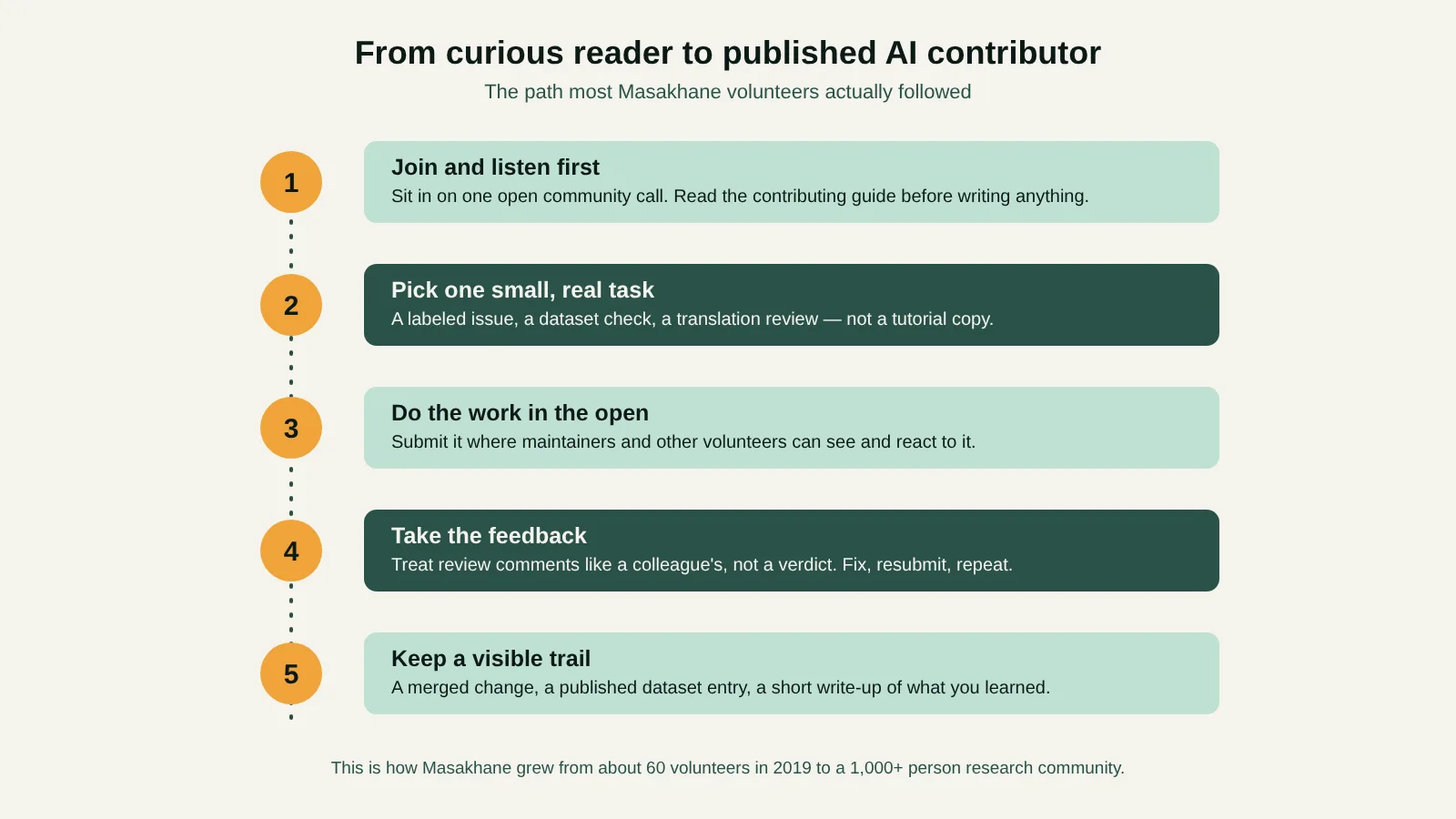
How to contribute to open-source AI projects, step by step
The Masakhane pattern generalizes well beyond language technology. Here is what it looks like applied to almost any open-source AI project, whether it's a model, a dataset, an evaluation benchmark or a developer tool.
- Pick a project by mission, not résumé value. You will do better, more consistent work on something you actually care about. Masakhane's long-term volunteers mostly wanted their own language represented, not a line on a CV.
- Lurk before you contribute. Join one open community call or read the contributing guide end to end before writing any code or data. Most open-source AI projects, including Masakhane, run these calls specifically to onboard newcomers.
- Start with the smallest real task you can find. A labeled "good first issue," a dataset quality check, or a documentation fix all count. The goal is a genuine, reviewable contribution, not a private exercise nobody else sees.
- Submit it where people can see and react to it. Working in the open, on a public pull request or shared notebook, turns practice into a track record and gets you real feedback instead of a guess.
- Treat review feedback as mentorship, not judgment. Experienced contributors correcting your work teaches you something a course can't: how people who actually ship AI systems think about edge cases and failure modes.
- Keep a visible trail. A merged pull request or a credited dataset entry is worth more to a future employer than an unverifiable claim that you "know AI."
A checklist before you call your first contribution done:
- You picked a task that was already labeled as open or requested, not one you invented yourself.
- Someone else on the project reviewed it, even briefly.
- You can point to it publicly: a merged change, a comment thread, a credited dataset entry.
- You wrote down, in a sentence or two, what surprised you or what you'd do differently next time.
- You know what the project's next open task looks like, so momentum doesn't stop here.
If language technology interests you, Masakhane's GitHub organization lists its repositories and open issues directly, with its community repository as the stated starting point. If a different domain draws you in instead, climate data, medical imaging, open speech models, the same pattern applies: the specifics change, the discipline doesn't.
What this means if you're trying to build real AI skills
Open-source contribution is a genuine way to learn AI by doing, and Masakhane shows it can lead to published research and institutional funding, not just a GitHub profile. But it has real limits: progress depends on volunteer time and goodwill, feedback can be slow, and no maintainer owes you a quick review. It rewards patience and a kind of self-direction that's hard to sustain alongside a full-time job or coursework.
That's where a structured program fills a different gap. If you'd rather build foundational AI skills with live feedback from instructors and a timeline you can plan around, the AI Generalist Certification at Indus AI Academy covers prompting, automation, building simple AI agents and shipping a small AI-powered app over live online sessions, ending in a capstone project reviewed by faculty and a verifiable certificate. It's a different path to the same destination: being someone who can actually build with AI, not just talk about it.
How to go deeper
Start small, this week, exactly as the checklist above describes: pick one open-source AI project connected to something you care about, read its contributing guide, and make one real, reviewable contribution before moving to a second one. If you want a broader map of what skills an "AI generalist" needs beyond any single project, our guide to what an AI generalist actually does breaks down model literacy, prompting, automation and judgment in more depth. And if you're also weighing a structured course alongside self-directed contribution, our checklist for choosing an AI course will help you tell a substance-first program from a tool tour.
Whichever path you take first, open-source contribution or a structured cohort, the underlying lesson from Masakhane holds either way: you don't need permission or a perfect résumé to start doing real AI work. You need one small task, done in the open, with people willing to tell you how to do it better.
Frequently asked questions
Can I contribute to open-source AI projects without a machine-learning background?
Yes. Masakhane is a documented example of a community built mostly by people without formal machine-learning training, who learned through shared notebooks, mentorship and open community calls. Many open-source AI projects maintain similar onboarding paths; look for a contributing guide, a community chat, and issues labeled for newcomers.
What is Masakhane and why is it a useful example?
Masakhane is a grassroots, pan-African natural language processing community founded in 2019 that builds open-source datasets, benchmarks and translation tools for African languages. It's a useful example because its growth, from about 60 volunteers to a 1,000-plus-person community with peer-reviewed publications and, as of 2026, institutional funding, is unusually well documented in its own published numbers and in independent reporting.
How do I find a good first task in an open-source AI project?
Check the project's issue tracker for labels like "good first issue" or "help wanted," read its contributing guide, and join any open community call or chat it runs. Masakhane, for instance, points newcomers to its community repository and runs weekly open meetings specifically for this purpose.
Does contributing to open source actually help with getting a job in AI?
A documented, reviewable contribution, a merged pull request, a credited dataset entry, or a published benchmark result, gives an employer something concrete to evaluate, which is generally more persuasive than an unverified claim of skill. It isn't a guarantee of a job offer, and progress through volunteer projects can be slower than a structured course, so many people combine both approaches.
How long does it take to make a meaningful open-source AI contribution?
There's no fixed timeline, and it depends entirely on the project and the task you pick. Masakhane's own history shows meaningful results compounding over years, not days, built one small, real contribution at a time rather than in a single burst of effort.
Found this useful?
Next cohort starts 1 Dec
AI Generalist Certification
Become the person on your team who gets things done with AI.
- Tuesdays, Thursdays and Saturdays, 7–9 PM IST
- 4 weeks · 12 sessions · 24 live hours · Online
- For: Professionals, managers, founders and career switchers
- ₹24,999 per seat, taxes extra
About the author
Vivek Gupta · IIT Delhi alumnus
Vivek Gupta is an IIT Delhi alumnus and PhD scholar, an AI researcher and serial entrepreneur with 14 years of building technology at MakeMyTrip, Goibibo, Wissen and Jubilant FoodWorks.
Discussion
No comments yet. Start the discussion.