Klarna's AI Customer Service Case Study: What Really Happened
Klarna's AI handled two-thirds of support chats and the work of 700 agents. Then it quietly started hiring humans back. Here's the full story.

Vivek Gupta · IIT Delhi alumnus
· 10 min read

In February 2024, the Swedish fintech company Klarna announced that an AI assistant was handling two-thirds of its customer service conversations and doing the work of 700 full-time agents. Fifteen months later, its CEO told Bloomberg that the company had gone too far and was hiring humans back. Both things happened at the same company, about the same system, and both are true. This Klarna AI customer service case study walks through what Klarna actually built, what its own numbers showed, why the strategy needed correcting, and what the full arc — not just the headline — teaches anyone building or buying AI systems today.
Key takeaways
- Klarna's AI assistant, built with OpenAI, handled about 1 in 3 customer service conversations within its first month and reportedly matched human agents on customer satisfaction.
- The company tied the rollout to roughly $40 million in expected profit improvement for 2024, and a steep drop in average resolution time.
- Klarna does not employ its own customer service agents; it uses outsourced providers, so the "700 agents" figure is a workload comparison, not 700 layoffs.
- In May 2025, CEO Sebastian Siemiatkowski said cost had become "a too predominant evaluation factor" and that the result was lower-quality service, so Klarna began hiring human agents again.
- The lasting design, as Klarna describes it now, is not AI-versus-humans. It is AI for high-volume, well-defined questions and humans for anything that needs judgment or that a customer specifically wants to discuss with a person.
What problem Klarna was actually trying to solve
Klarna is a "buy now, pay later" and digital banking company serving more than 150 million customers across 23 markets. At that scale, customer service is enormous and repetitive: most conversations are some version of "where is my refund," "did my payment go through," or "why was I declined." Answering those well, fast, in dozens of languages, at any hour, is a logistics problem as much as a support problem.
In late January 2024, Klarna launched an AI assistant built on OpenAI's technology, embedded directly in its app and connected to live account data: payments, balances, refunds and order history, not just a static FAQ. Within a month, Klarna reported in its own figures, as covered by Fortune, that the assistant had handled 2.3 million conversations, about two-thirds of all its customer service chats, doing the equivalent work of roughly 700 full-time agents.
The numbers Klarna reported, and what they actually mean
Here is what the company said about performance in that first month, as reported across multiple outlets that covered the announcement directly:
| Metric | What Klarna reported |
|---|---|
| Share of chats handled by AI | About two-thirds (66%) |
| Conversations in the first month | 2.3 million |
| Workload equivalent | About 700 full-time agents |
| Customer satisfaction | On par with human agents |
| Repeat inquiries | Down 25% |
| Average resolution time | Fell from 11 minutes to about 2 minutes |
| Markets and languages | 23 markets, 35+ languages, available 24/7 |
| Estimated profit impact for 2024 | About $40 million |
A few things are worth separating from the headline. First, these are company-reported figures, not independently audited numbers; treat them the way you would treat any vendor's own case study. Second, American Banker's coverage pointed out an important nuance: Klarna does not directly employ the customer service agents it is comparing itself against. Those are outsourced staff at third-party providers, so "the work of 700 agents" is a capacity comparison against contracted headcount, not a company announcing 700 layoffs. In a separate interview, Klarna's CEO told CBS News that the staffing level needed from those outsourced teams fell from about 3,000 agents to a little over 2,000, and that Klarna's own headcount reductions (around 800 jobs in 2022) had happened earlier and for different reasons, which he said had been wrongly "conflated" with the AI story.
What's genuinely notable, from a builder's perspective, is the integration. According to a technical summary of the deployment, the assistant wasn't a bolt-on chatbot answering from a script. It was wired into live payment processing, account data and refund systems, with a standing option for the customer to switch to a human at any point, plus ongoing audits and compliance checks for each regulated market. That combination — real data access, a human fallback built in from day one, and monitoring — is the part worth copying. The 700-agent number is the part worth reading skeptically.
Where it went wrong: optimizing for the wrong thing
For a while, the story seemed to end there: AI absorbs the repetitive work, cost falls, satisfaction holds up. Then, in May 2025, Siemiatkowski gave an interview to Bloomberg that changed the framing. As PYMNTS reported on the interview, he said that in building the AI-first model, "cost seems to have been a too predominant evaluation factor," and that doing so produced "lower quality" service. Klarna had paused hiring for more than a year while leaning on the AI assistant; he said that approach was no longer the right one, and that the company would start hiring human agents again so customers could always reach a person if they wanted one. The new roles were structured as flexible, remote positions — what he called an "Uber type of setup" — aimed at replacing the outsourced human capacity Klarna had been drawing down.
This is the detail most retellings of the Klarna story skip, and it's the most useful part. A system can hit every metric in its own press release — volume handled, cost saved, satisfaction scores matching humans — and still be the wrong design, if the metric it was tuned for (cost per conversation) wasn't the metric that mattered most to the business (long-term service quality and trust). Measuring "is it cheaper" and measuring "is it actually good" are different questions, and Klarna's own account is that it let the first one crowd out the second.
A month later, at an SXSW event in London, Siemiatkowski reframed the plan again, telling the audience that "we think offering human customer service is always going to be a VIP thing," comparing it to the premium people pay for handmade goods over mass-produced ones. By mid-2025, Klarna's total headcount had dropped from about 5,527 (December 2022) to roughly 3,422 (December 2024), a decline of around 40% driven by the hiring freeze and productivity gains, not by this one AI rollout alone — and the company was now rebuilding a visible human option on top of it.
The model Klarna settled on
By late 2025, in comments reported by CMSWire, Klarna pushed back on the idea that it was retreating from AI at all. The assistant, it said, now handles about 1.3 million "errands" a month, equivalent to roughly 800 people, still around two-thirds of chats, with the same reported satisfaction parity and the same roughly 2-minute average resolution time. What changed is the human side: Klarna is hiring people specifically for the harder, higher-trust conversations it used to outsource, while the AI tier keeps absorbing the high-volume, well-defined questions. The diagram below shows that split as Klarna has described it.
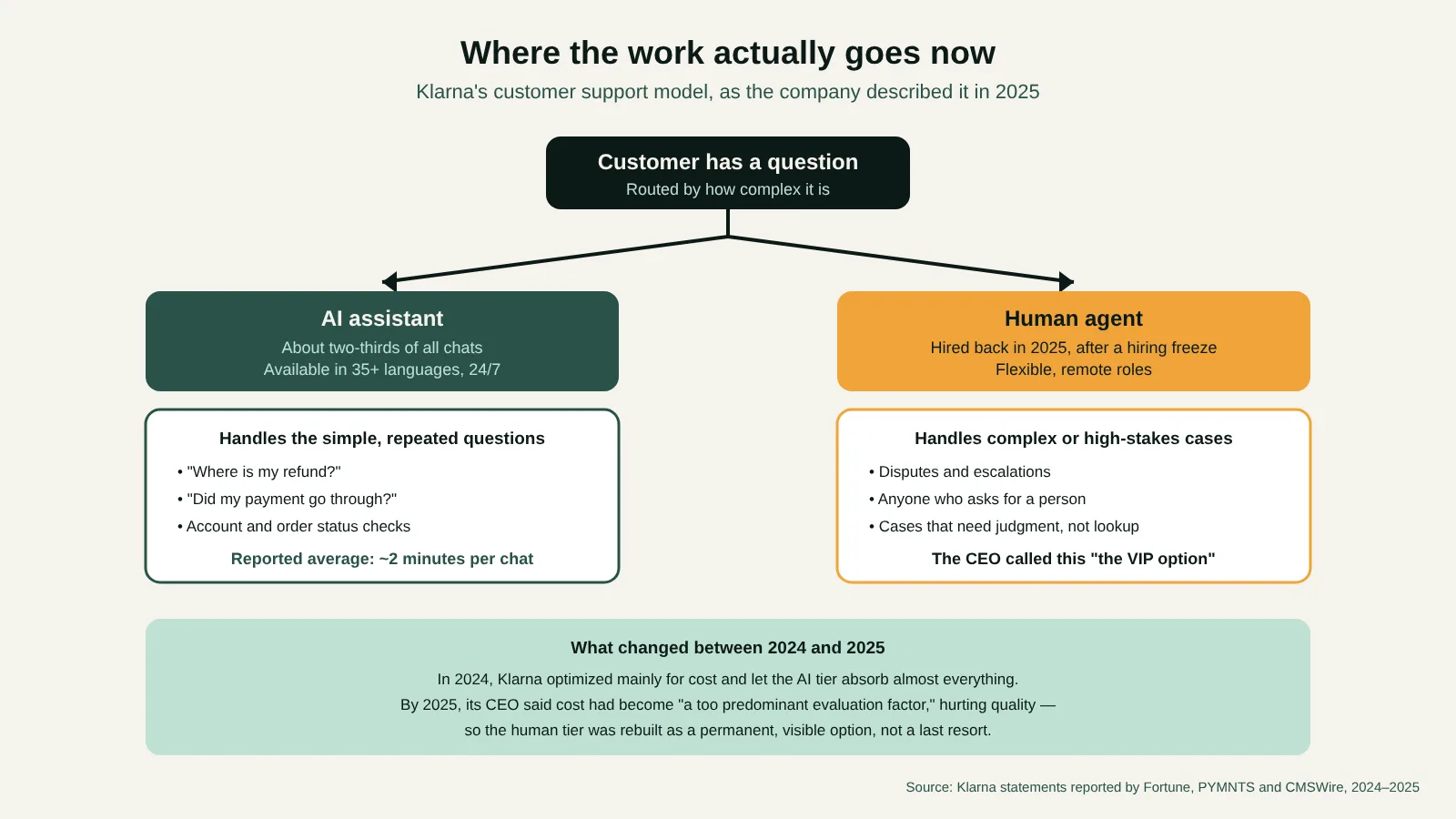
This is a genuinely useful design pattern, independent of whether you believe every number in Klarna's press releases: route by complexity and stakes, not by a blanket "replace the team" or "don't touch the team" decision. The questions that are high-volume and low-ambiguity — where's my refund, did my payment clear — are exactly the kind of work language models are reliable at, because the answer lives in a system of record and there's one right response. The questions that involve a dispute, an angry customer, or a judgment call about an exception to policy are exactly the kind of work that benefits from a person who can weigh context the system doesn't capture.
Four lessons for anyone building or buying AI systems
Measure quality, not just volume, from day one. Klarna's own account is that cost-per-conversation became the dominant metric, and quality suffered as a result. If you're automating a workflow, decide upfront what "good" means beyond "cheaper" or "faster" — and keep measuring it after launch, not just at the pilot stage.
Keep a visible, permanent human option, not a buried one. Klarna's assistant had a switch-to-human option from the start, and by 2025 the company was actively promoting that option rather than hiding it. A fallback that exists on paper but is hard to find isn't the same as one customers actually know about and trust.
"Equivalent to X people" is a capacity claim, not a headcount announcement. Whenever you read that AI is "doing the work of" some number of employees, ask who those people were (direct staff or outsourced vendors), and whether the company's own headcount moved for that reason or for separate business decisions. Klarna's case shows both things can be true in the same announcement.
Redesign where the work goes, don't just speed up the old process. The lasting change at Klarna wasn't "a chatbot that answers faster." It was a redesign of which conversations go where — a theme that shows up across other large AI rollouts, including how AI pays off when you redesign the process, not the task, and in how Wipro described freeing up capacity rather than cutting roles in its own AI rollout.
- Define the quality metric you'll track alongside cost before you launch, not after a customer complains.
- Keep the human option visible in the product, not buried three menus deep.
- Separate vendor-capacity numbers from your own headcount when you report results internally.
- Re-check the split every quarter — the right AI-to-human ratio for a growing company isn't fixed.
- Budget time for monitoring, since even a well-built assistant creates real oversight work; see the hidden time cost of babysitting AI for what that looks like in practice.
Frequently asked questions
Did Klarna's AI actually replace 700 jobs?
Not directly. Klarna said its AI assistant was doing work equivalent to about 700 full-time agents, but those agents were staff at outsourced customer service providers, not Klarna employees. Klarna's own headcount did fall sharply over the following two years, driven by a hiring freeze and broader productivity gains, not a single announced layoff tied to this system.
Why did Klarna start hiring human customer service agents again?
In May 2025, Klarna's CEO told Bloomberg that the company had optimized too heavily for cost when designing its AI-first support model, and that doing so produced lower-quality service. Klarna began hiring human agents in flexible, remote roles so customers could reliably reach a person, alongside continued use of the AI assistant for high-volume questions.
Is Klarna's AI customer service still in use?
Yes. As of late 2025, Klarna said its AI assistant was handling more conversations than before, not fewer, while human agents were hired for more complex or high-trust conversations that used to be outsourced. The company describes this as expanding both AI and human capacity, not choosing one over the other.
What is a human-in-the-loop support model?
It's a design where AI handles high-volume, well-defined requests, and a person is always available for cases that need judgment, carry higher stakes, or that the customer specifically wants to discuss with a human. Klarna's 2025 model, with AI handling roughly two-thirds of chats and humans available for escalations and disputes, is a real-world example of this pattern.
Can AI replace customer service jobs entirely?
The Klarna case argues against a clean yes. AI can absorb a large share of repetitive, well-defined requests reliably, but Klarna's own experience is that cutting humans out of service entirely, driven mainly by cost, hurt the quality customers experienced. The more durable pattern companies are converging on is AI for volume and humans for judgment, not full replacement.
How to go deeper
Reading one company's case study is useful, but the skill that transfers is being able to look at any AI rollout — your own team's or a vendor's pitch — and ask the right questions: what exactly is being measured, who is being compared to whom, and what happens when the metric you optimized for stops matching the outcome you actually wanted. That's a leadership and judgment skill, not a technical one, and it's exactly what Indus AI Academy's AI for Leaders program is built around: six live sessions where you leave with your own AI opportunity map, a vendor evaluation scorecard, and a governance checklist you can apply to decisions like the one Klarna made and then partly reversed.
If you lead a team, or you're about to sign off on an AI rollout of your own, the next cohort of AI for Leaders is a useful place to pressure-test the plan with people who've seen these trade-offs before you commit to them, with live feedback on the actual use case you bring to class.
Klarna's story isn't a cautionary tale against AI in customer service — the first-month numbers were real, and the assistant is still handling most of the company's chats today. It's a case study in what happens when you optimize for one number and forget to watch the others, and in how a well-run company course-corrected once it noticed.
Found this useful?
Next cohort starts 1 Dec
AI Generalist Certification
Become the person on your team who gets things done with AI.
- Tuesdays, Thursdays and Saturdays, 7–9 PM IST
- 4 weeks · 12 sessions · 24 live hours · Online
- For: Professionals, managers, founders and career switchers
- ₹24,999 per seat, taxes extra
Related
AI for Leaders
About the author
Vivek Gupta · IIT Delhi alumnus
Vivek Gupta is an IIT Delhi alumnus and PhD scholar, an AI researcher and serial entrepreneur with 14 years of building technology at MakeMyTrip, Goibibo, Wissen and Jubilant FoodWorks.
Discussion
No comments yet. Start the discussion.