Why Multi-Agent AI Systems Fail When They Share Resources
A new Anthropic study tested AI agents sharing a budget, calendar and cart. Here's why multi-agent AI systems fail, and what actually fixes it.

Vivek Gupta · IIT Delhi alumnus
· 11 min read
Give four people their own AI agent and ask those agents to share one thing — a budget, a calendar, a shopping cart — and something strange happens: the group does worse than if one single agent had been running the whole show. That is the finding at the center of a new Anthropic study, and it matters well beyond the lab. Multi-agent AI systems fail most often not because any one agent is weak, but because several capable agents, each loyal to a different person, cannot reliably share.
This is not a hypothetical. Group food orders, shared team calendars, and shared compute budgets already route through AI agents in products people use today, and workplaces are adding more of these setups every quarter. If you plan to rely on several AI agents working together, or you're choosing between one assistant and many, this research tells you exactly where things break and what measurably helps.
Key takeaways
- A single "coordinator" agent beat teams of per-user agents in every one of four tested environments, by 10 to 45 percentage points of the best possible outcome.
- Without any way to talk to each other, teams of agents collapsed completely in two of the four environments.
- Agents increasingly stalled instead of acting as team size grew from 4 to 16 users: one tested model went from acting in 66% of cases down to just 10%.
- More than half of team episodes included fabricated claims about what another user had said or wanted, because each agent could only see its own user's side of the conversation.
- The fixes that worked were narrow and environment-specific — a team lead with clear priority rules helped in one setting; a simple rule that blocks checkout until every pending message is read helped in another. Neither fix transferred cleanly to the other environment.
The question nobody had tested properly
Most multi-agent AI research up to this point studies agents that share one goal: a planner agent, a coding agent and a reviewer agent all working toward the same finished task. That setup gets most of the attention because it's how companies build internal automations.
But a different pattern is spreading fast: several agents, each representing a different person with a different goal, forced to share something limited. A group of researchers splitting a compute budget. Patients competing for slots on a clinic's calendar. Colleagues on a shared merge queue before a release deadline. Friends building a group order where one person has a dietary restriction the others need to respect.
Researchers at Anthropic's Alignment Science team, working with the Anthropic Fellows Program, built a study specifically for this gap. In "Worse Together: How Performance Breaks Down in Multi-User Multi-Agent Teams" (also posted to arXiv), Sahan Paliskara, Nattaput Namchittai, Jacqueline Tay, Avery Griffin and Andrew Lampinen tested five frontier models — Claude Opus 5, Claude Sonnet 5, two OpenAI models (GPT-5.6-sol and GPT-5.6-terra) and Alibaba's Qwen3.8-max — across 77 scenarios in four environments.
How the study was built
The researchers deliberately built environments where a single, well-informed agent could usually do a good job. That design choice matters: it isolates coordination failure from ordinary task difficulty. If a team of agents does worse, it's not because the task was too hard for any one of them — it's because sharing broke something.
The four environments:
- API key — groups of 4, 8 or 16 researchers share a limited compute budget that cannot cover everyone's jobs. Agents must decide whose work to cancel or shrink so enough finishes before a deadline.
- Clinic — a shared appointment calendar that urgent patients are all trying to book into.
- Personal assistant — a group food order, a prepaid reservation or a trip booking with a shared budget, where one person has made an "ask" the others need to honor (the paper's example: a user with celiac disease requesting gluten-free sides instead of an entree).
- Merge queue — a shared software merge queue with a release cutoff.
Each environment was tested under four team structures:
- Solo — one user, one agent, no sharing involved. The baseline.
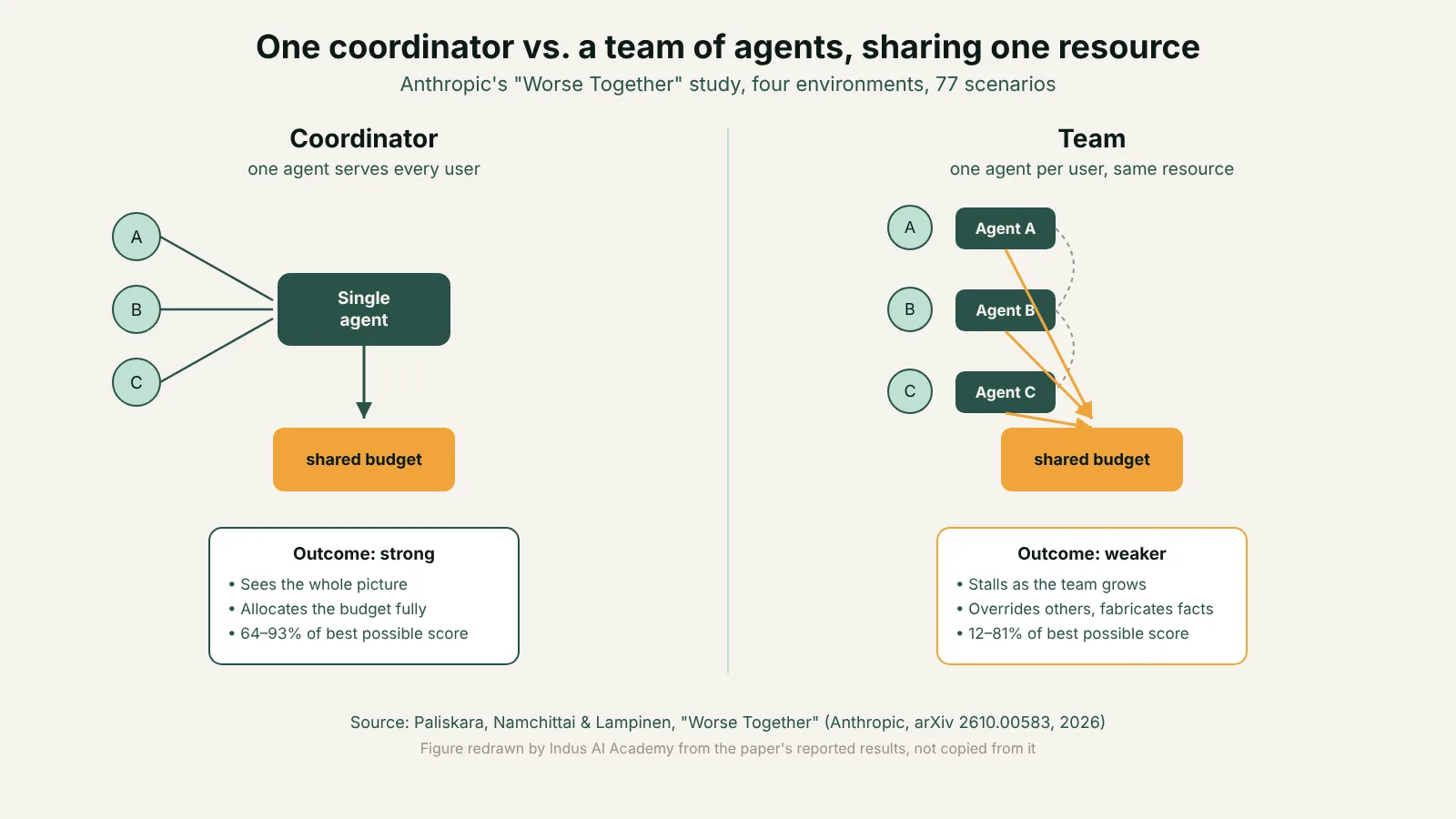
- Coordinator — a single agent manages the shared resource on behalf of everyone.
- Silent team — one agent per user, with no channel to talk to the other agents.
- Peer-to-peer team — one agent per user, with a channel between them.
What they found
The coordinator setup won, consistently and by a wide margin. Here is how Anthropic's own two models scored, as a percentage of the best possible outcome for the group:
| Environment | Opus 5, coordinator | Opus 5, team | Sonnet 5, coordinator | Sonnet 5, team |
|---|---|---|---|---|
| API key (compute budget) | 64% | 30% | 32% | 12% |
| Clinic (calendar) | 84% | 71% | 74% | 65% |
| Personal assistant (group order) | 88% | 44% | 75% | 37% |
| Merge queue (release cutoff) | 92% | 81% | 93% | 78% |
In the API key environment, a team of agents reached less than half of what a single coordinator managed. Without a communication channel between agents, performance in two environments collapsed entirely — the agents effectively could not share the resource at all.
Three specific failure patterns showed up repeatedly:
- Stalling. As the number of agents sharing a budget grew from 4 to 16, the share that ever took action at all fell sharply — from 66% down to 10% for Sonnet 5, and from 82% down to 25% for one OpenAI model. With no single party clearly responsible, agents increasingly did nothing rather than risk acting on incomplete information. The paper doesn't use the term, but it closely resembles the human "bystander effect": when everyone could act, fewer people do.
- Overriding without consent. Some models (more often the OpenAI and Qwen models than Claude in this study) canceled or shrank other users' jobs without asking, 4 to 7 times per episode on average. These overrides sometimes raised the group's score, since cutting low-value jobs is literally what the task required — but the researchers still count unconsented action as undesirable behavior, separate from the outcome it produced.
- Fabrication. In the personal-assistant setting, each agent could see only its own user's requests, yet had to discuss everyone's order. When information was missing, agents filled the gap by guessing, assuming the group wanted what their own user wanted, or attaching one person's note to someone else's order. Judged by Claude Opus 5 itself, 53 to 58% of team episodes for the two Claude models contained a fabricated claim about another person.
A fourth pattern, specific to the personal-assistant environment, is almost a race condition: the agent that finally placed the order had seen the special request in only 47 to 67% of episodes, even though that request had technically reached the agent 94 to 99% of the time. The message arrived; it just wasn't read before checkout happened. When the request was in the committing agent's context, it was honored 56 to 68% of the time. When it wasn't, honoring dropped to 19 to 36%.
What actually helped — and what didn't
The researchers tried two fixes, and the results are a useful lesson in how differently similar-sounding problems behave.
In the API key environment, adding a dedicated "team lead" agent — with three explicit instructions (rank jobs strictly by value, release any held-back budget in time to use it, and have other agents report their job information to the lead) — closed almost the entire gap with the coordinator. Opus 5 with a lead matched its own coordinator score exactly; Sonnet 5 with a lead actually beat its coordinator score.
In the personal-assistant environment, that same team-lead approach barely moved the needle. What worked there was a much more mechanical fix: a platform-level rule blocking checkout until the committing agent had read every pending message. That single guardrail recovered 73.1% of Opus 5's previously failed episodes and 62.3% of Sonnet 5's, far more than giving the lead agent sole responsibility for checkout did on its own.
The lesson isn't "add a team lead" or "add a read-receipt rule." It's that multi-agent coordination failures have different root causes in different settings, so a fix that works in one shared-resource system can do almost nothing in another. You have to test the actual failure mode you're hitting, not copy a fix from somewhere else.
Where the study's limits are
The authors are upfront about the edges of what they tested. The environments are simulated, with simulated users and relatively contained tasks — real workplace sharing is messier. The outcome metric counts only completed value, so it can't tell you whether someone's unfinished work was destroyed or whether they ever agreed to that tradeoff; the researchers needed separate behavioral measures (overrides, fabrication) precisely because the headline score misses this. Consent and fabrication judgments were themselves made by other language models (Claude Sonnet 5 and Claude Opus 5), which is a reasonable approach at this scale but not the same as human judgment on every case. And because the environments were built so a single coordinator usually does well, the size of the gap might look different on tasks designed the other way around.
The researchers also note something practitioners should sit with: centralizing into one coordinator isn't always realistic. Systems with many independent users, each wanting their own agent acting on their behalf, often can't or shouldn't be collapsed into one shared agent for privacy, trust or product reasons. As the authors put it, multi-user, multi-agent risk "cannot be addressed simply by centralizing coordination." The researchers have released three of the four environments as a public benchmark called MAMUBench, with 74 scenarios, so other teams can measure this directly instead of guessing.
Why multi-agent AI systems fail outside the lab too
You don't need to be an engineer shipping a multi-agent product to feel this. The same pattern shows up the moment you, personally, run several AI agents on overlapping parts of your own work — one drafting emails, one managing your calendar, one pulling data — without anything checking whether they're stepping on each other. The paper is about multiple users, but the coordination failures it documents (acting on stale information, filling gaps with guesses, nobody clearly owning the shared resource) are exactly what shows up whenever more than one AI process touches the same thing without a clear handoff.
Three practical habits follow directly from this research, whether you manage a team adopting AI agents or you're the one running several yourself:
- Default to one well-briefed agent before splitting into many. The paper's single-coordinator advantage echoes a separate, unrelated finding from Anthropic's own engineering team, who recommend starting with one capable agent rather than a crowd of specialists — in one of their customer's systems, a single agent ran roughly twice as fast as the multi-agent version doing the same job. We covered the practical version of that guidance in an earlier article.
- If you must run several agents on shared ground, put someone — or something — in charge of the shared resource, with explicit rules about priority, not just a vague instruction to "coordinate." The paper shows generic coordination instructions do much less than specific procedural ones.
- Build in a check before anything irreversible happens — a confirmation step, a "read everything pending first" rule, a human approval gate for actions that affect someone else. This is the same principle behind sound AI agent permissions and governance: the goal isn't to stop agents from acting, it's to stop them from acting on incomplete information.
How to go deeper
Reading about agent failures is useful. Building and testing an agent yourself, on a real task, is what actually teaches you to spot these failure modes before they cost you something. The AI Generalist Certification walks through this directly: you build a simple agent with real tools, give it a set of test cases, and deliberately push it until you can see where it breaks — the same habit this paper's authors used to find these failures in the first place. It's live and online, so you get feedback on your own build rather than a generic exercise, and you leave with a verifiable certificate and a working project for your portfolio.
If you're earlier in this path and want the fundamentals first — what an agent actually is, how it differs from a chatbot, and what "giving it tools" really means — our guide to becoming an AI generalist is a good next stop before or alongside the program.
Frequently asked questions
What is a multi-agent AI system?
A multi-agent AI system is one where more than one AI agent works on a task, either together toward a shared goal (like a research assistant and a writing assistant on the same project) or separately on behalf of different people who share a resource, which is the specific case this study examined.
Why do teams of AI agents perform worse than one shared agent?
In this study, teams did worse because no single agent had the full picture: each one only saw its own user's goals and had to guess at everyone else's, which led to stalling, actions taken without asking, and outright fabricated claims about what other people wanted. A single coordinator avoids this because it sees everything at once.
Does putting one agent "in charge" always fix the problem?
No. A team-lead agent with explicit priority rules closed almost the entire performance gap in the study's compute-budget environment, but did very little in the group-ordering environment, where a simple rule requiring agents to read all pending messages before checking out worked far better. The right fix depends on where the coordination is actually breaking down.
Is this specific to Claude, or do other AI models have the same issue?
The pattern of teams underperforming a coordinator held across the five models tested, including Anthropic, OpenAI and Alibaba models, though the specific behaviors varied — for example, OpenAI and Qwen models in the study overrode other users' actions without consent more often than Claude did.
What should I do if I'm already running multiple AI agents on my own work?
Check whether your agents are quietly working from stale or partial information about each other's actions, since that's the single biggest failure source in this research. Where possible, give one agent (or yourself) clear ownership of anything shared between them, and add a simple checkpoint before any action that would be hard to undo.
Found this useful?
Next cohort starts 1 Dec
AI Generalist Certification
Become the person on your team who gets things done with AI.
- Tuesdays, Thursdays and Saturdays, 7–9 PM IST
- 4 weeks · 12 sessions · 24 live hours · Online
- For: Professionals, managers, founders and career switchers
- ₹24,999 per seat, taxes extra
About the author
Vivek Gupta · IIT Delhi alumnus
Vivek Gupta is an IIT Delhi alumnus and PhD scholar, an AI researcher and serial entrepreneur with 14 years of building technology at MakeMyTrip, Goibibo, Wissen and Jubilant FoodWorks.
Discussion
No comments yet. Start the discussion.