AI and the Future of Jobs: What the 2026 Data Actually Shows
WEF, ILO, IMF and Stanford's 2026 data on AI and the future of jobs: who is most exposed, how the risk differs by country, and which skills hold up.

Vivek Gupta · IIT Delhi alumnus
· 12 min read

Ask ten people what AI and the future of jobs actually looks like, and you'll get ten confident, contradictory answers. Some will quote a headline about 92 million jobs disappearing. Others will quote a different headline about 170 million jobs appearing. Both numbers come from the same report, and neither tells you what's actually happening to the work in front of you right now.
This article pulls together four of the most rigorous studies available: the World Economic Forum's Future of Jobs Report 2025, the International Labour Organization's refined global exposure index, the IMF's cross-country analysis, and Stanford's 2026 AI Index, which tracks real hiring data rather than projections. Read together, they tell a more useful and more honest story than any single headline: AI's effect on work is real, uneven, already measurable in specific places, and still mostly a matter of task change rather than wholesale job loss.
Key takeaways
- The WEF projects a net gain, not a net loss. By 2030, employer surveys point to 170 million jobs created and 92 million displaced worldwide — a net +78 million, alongside churn affecting 22% of today's formal jobs.
- "Exposure" is not the same as job loss. The ILO estimates one in four workers globally are in occupations with some exposure to generative AI, but its researchers conclude that transformation, not elimination, is the more likely outcome for most of those jobs.
- Where you live changes your risk a lot. The IMF finds AI exposure runs near 60% in advanced economies versus roughly 26% in low-income countries, because richer economies have far more office-based, cognitive-task jobs to begin with.
- Real hiring data shows an early, narrow effect. Stanford's 2026 AI Index finds employment for software developers aged 22–25 has dropped close to 20% since 2024 — the clearest sign yet that the impact is landing first on entry-level, easily-automated tasks.
- The skills gap, not AI itself, is what's shifting fastest. Employers report that 39% of workers' core skills will change by 2030, and they rank AI and big data as the fastest-growing skill area worldwide.
How many jobs will AI actually create or destroy by 2030?
Start with the number everyone quotes. The World Economic Forum's Future of Jobs Report 2025 surveyed more than 1,000 employers, representing over 14 million workers across 55 economies and 22 industry clusters. Its headline projection: by 2030, 170 million jobs will be created and 92 million displaced, a structural churn equal to 22% of the 1.2 billion formal jobs in its dataset. Net that out and you get a gain of 78 million jobs, or 7% growth.
Two things are worth knowing before you repeat that number. First, it is not AI-only — the report folds in automation, robotics, demographic shifts and the green transition as combined drivers. Second, it is a survey of employer intentions, not a record of jobs already lost or gained. Employers are telling researchers what they plan to do, which is useful, but it is a forecast, not a fact.
The report is specific about where the losses and gains land. Clerical and secretarial roles — cashiers, administrative and executive assistants, data entry clerks, bank tellers and postal service clerks — are expected to see the largest declines in absolute numbers. On the growth side, Big Data Specialists, FinTech Engineers, AI and Machine Learning Specialists, and Software and Applications Developers top the list, alongside renewable energy engineers tied to the separate green-transition trend. Employers also plan to manage the shift actively: 85% intend to prioritize upskilling, and 50% expect to move staff from declining roles into growing ones rather than simply laying them off.
What "exposure" actually means — and why one in four jobs qualifies
A different, more precise question is how many jobs today already overlap with what generative AI can do. This is what researchers call "exposure," and it is where the ILO's refined Global Index of Occupational Exposure, built with Poland's NASK research institute, is the most careful source available. Rather than guessing from the outside, the researchers mapped nearly 30,000 individual occupational tasks, scored each one's automation potential using large language models, then checked those scores against a survey of 1,640 working people and expert review panels.
Their finding: globally, one in four workers are in an occupation with some exposure to generative AI, and 3.3% of global employment falls into the highest exposure category, where most of a job's tasks overlap closely with current AI capability. Two patterns stand out. Clerical work shows the highest concentration of high-exposure tasks of any occupational group, matching what the WEF separately reports about declining clerical roles. And exposure splits sharply by gender in wealthier countries: in the highest-exposure category, 9.6% of women in high-income countries work in exposed roles compared with 3.5% of men, largely because clerical and administrative work is still disproportionately done by women.
Crucially, the ILO researchers are explicit that exposure is a ceiling on what could change, not a prediction of what will disappear: "transformation is more likely than elimination," since most roles bundle tasks that still require a human in the loop even when individual tasks get faster with AI.
Where you live changes the picture more than you'd expect
If exposure is uneven across occupations, it is even more uneven across countries, and this is the part of the AI-and-jobs conversation that gets flattened the most in headlines. The IMF's 2024 staff discussion note, Gen-AI: Artificial Intelligence and the Future of Work, lays out the gap directly: almost 40% of global employment is exposed to AI, but that average hides a steep divide. In advanced economies, about 60% of jobs are in high-exposure occupations, rising to nearly 70% in the UK and around 60% in the US. In emerging markets, the share is closer to 40%, and in low-income countries it falls to about 26%. Even within the emerging-market group, the range is wide: the IMF puts Brazil near 41% and India near 26%, reflecting how much of each economy's workforce still sits in agriculture, informal trade and in-person services that current AI tools don't reach.
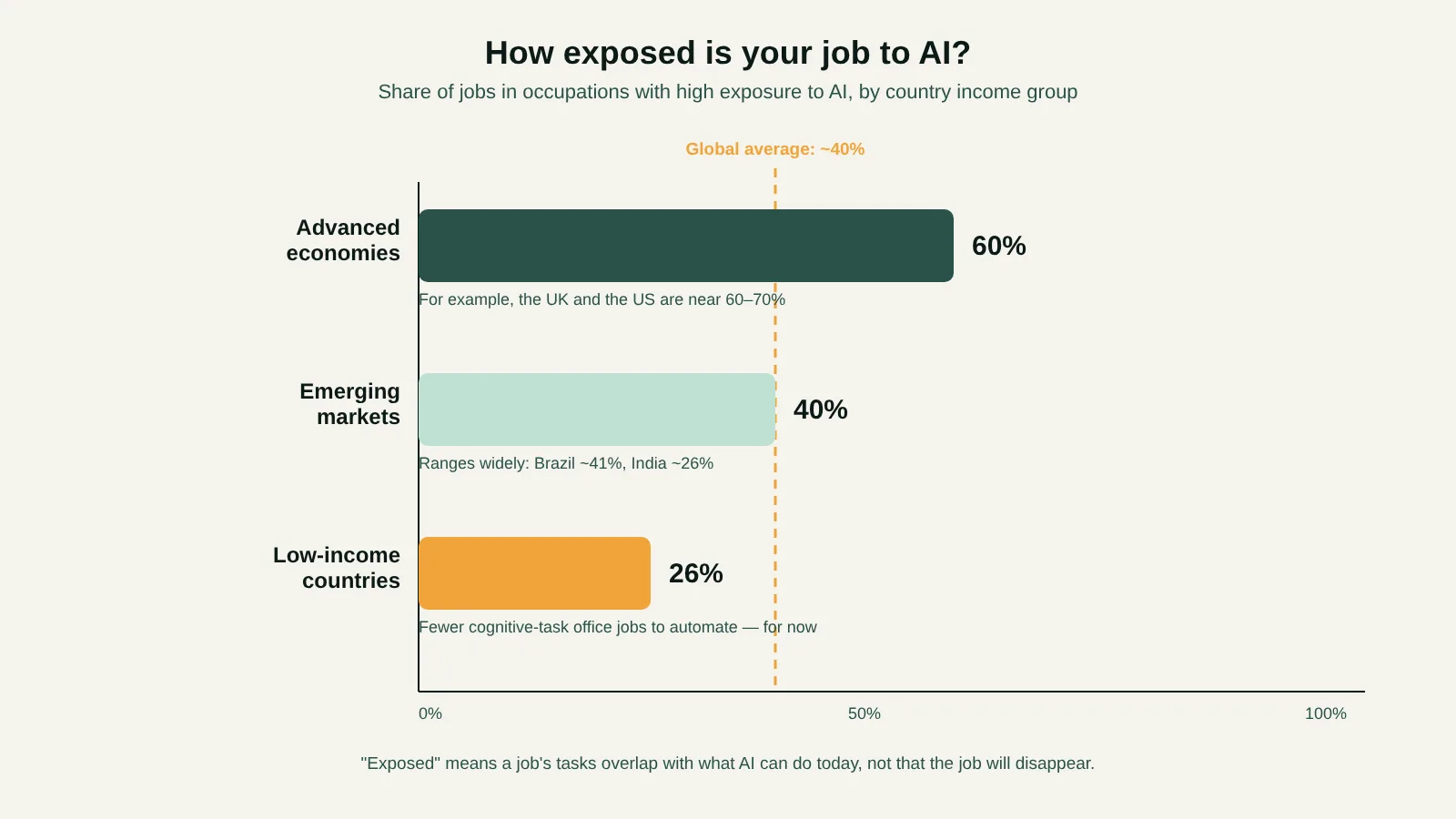
The IMF's deeper point is about who benefits, not just who's exposed. Women and college-educated workers show up as more exposed to AI than average, but the report also finds them typically better positioned to benefit, because their jobs often pair exposed tasks with judgment and client relationships that AI can assist rather than replace — what the researchers call "shielding." A judge's work is highly exposed in principle (drafting, research, summarization) but highly shielded in practice, since final judgment stays with a human. A clerical worker's tasks are just as exposed but far less shielded, which is why clerical and data-entry roles decline across almost every study here. Older workers, meanwhile, may find it harder to adapt regardless of how exposed or shielded their role is — a reskilling gap, not a technology gap.
Where the impact is already showing up, not just projected
Surveys and exposure indexes describe what could happen. Stanford's 2026 AI Index is one of the first major reports to show what's already happening, using real hiring data rather than employer intentions. Its most striking finding: employment for software developers aged 22 to 25 has fallen nearly 20% since 2024, with a similar, smaller decline among young workers in customer support roles. Most older age groups in the same occupations grew over the same period. The pattern suggests AI's current effect is concentrated in hiring pipelines and entry-level tasks — the first rung of a career ladder that AI coding assistants and support tools can now partly cover — rather than in broad layoffs of experienced staff.
The same report finds employer expectations more cautious than the headlines suggest: 32% of organizations expect AI to reduce their workforce in the next year, while 43% expect little or no change. Expected reductions concentrate in service operations, supply chain and software engineering, and large-scale job losses have not yet shown up in aggregate employment data, even though expectations outpace the cuts companies have actually made. On productivity, the gains are real but uneven: output gains run around 14–15% in customer support, 26% in software development tasks, and as much as 50% in marketing output, with much smaller gains on work that requires deeper reasoning. One caution worth carrying forward: early evidence in the same report suggests leaning on AI too heavily, too early in a career, may slow the development of the underlying skill — a reason to use AI to go faster at a skill you're still building, not instead of building it.
Which skills are rising, and which are fading
Put the exposure data and the hiring data together and a consistent list of winners and losers emerges. The WEF's employer survey ranks AI and big data as the fastest-growing skill worldwide, just ahead of networks and cybersecurity and technology literacy, and reports that workers can expect 39% of their core skill sets to change between 2025 and 2030 — down, notably, from 44% in the 2023 edition, suggesting the first wave of reskilling is starting to catch up with the pace of change.
| Fastest-growing roles (WEF, 2025–2030) | Fastest-declining roles (WEF, 2025–2030) |
|---|---|
| Big Data Specialists | Postal Service Clerks |
| FinTech Engineers | Bank Tellers |
| AI and Machine Learning Specialists | Data Entry Clerks |
| Software and Applications Developers | Cashiers and Ticket Clerks |
| Renewable Energy Engineers | Administrative and Executive Secretaries |
Analytical thinking remains the single most sought-after core skill overall — seven in ten employers call it essential — which matches what the AI generalist role has become in practice: not writing better prompts, but knowing which problem is worth solving, judging AI's output, and connecting tools into a workflow that actually ships. That's also the thread running through why organizations that have AI skills but haven't redesigned the work around them still don't see the productivity gains in their numbers — the skill and the system have to move together.
What this means for you, wherever you're starting from
The honest answer to "will AI take my job" is: it depends far more on which tasks your job is made of than on your job title, and far more on where you live and what you do next than on any global average. Here's what the data above suggests, by starting point:
- Students and new graduates: The clearest, most concrete signal in this data is Stanford's finding on entry-level software and support roles. Build a portfolio of real, reviewed work (not just coursework) before you need the job, because the lowest rungs of some career ladders are getting narrower, not wider.
- Professionals in a clerical, administrative or data-entry-heavy role: You're in the highest-exposure category in every study here. That's not a verdict on your value — it's a signal to move toward the judgment and exception-handling parts of your job now, while you have time to do it deliberately.
- Career changers: Exposure cuts both ways — the same AI tools that threaten some roles are what make it realistic to move into an AI-adjacent role from almost any starting point, if you build toward where the fastest-growing skills list points.
- Managers and small business owners: The WEF data shows 85% of employers plan to upskill rather than just replace, and the IMF data shows exposed-but-shielded roles do better than exposed-and-unshielded ones. Redesigning a role around judgment and oversight is a decision you can make for your own team this quarter, not something to wait on.
A short checklist, regardless of where you sit:
- Name the specific tasks in your role that overlap with what AI already does well (drafting, summarizing, classifying, searching).
- Pick one of those tasks and build a habit of using AI to do it faster, while you keep doing the judgment call yourself.
- Identify the parts of your job that require oversight, client trust or accountability — your "shielding" — and get visibly better at them.
- If your role looks like the fastest-declining list above, start learning toward the fastest-growing list before the decision is made for you.
How to go deeper
None of this requires a technical background to act on. The skills that show up across every report here — judging AI output, structuring a workflow, knowing where a model's answer needs a human check — are what a practical, build-first program teaches. Indus AI Academy's AI Generalist Certification runs as a live online cohort with instructor feedback on your own work, a portfolio project drawn from a real problem you bring, and a certificate anyone can verify, for professionals, career changers and graduates who want to move from reading about AI and jobs to being harder to displace. The next cohort is open for enrollment now.
The clearest takeaway from four independent, rigorously sourced reports is that AI is changing the shape of most jobs faster than it is deleting most jobs outright — and that the difference between those two outcomes, for any individual, usually comes down to whether they adapted before or after the task list changed under them.
Frequently asked questions
Will AI take my job?
For most roles, the data points to task change rather than outright elimination. The ILO's research concludes that generative AI is more likely to transform occupations — automating specific tasks — than to eliminate them entirely, because most jobs bundle tasks that still need human judgment, accountability or oversight. The exception is highly exposed, lightly "shielded" roles such as clerical and data-entry work, where the IMF and WEF both find the sharpest declines concentrated.
How many jobs will AI create and destroy by 2030?
The World Economic Forum's Future of Jobs Report 2025, based on a survey of more than 1,000 employers across 55 economies, projects 170 million jobs created and 92 million displaced by 2030, a net gain of 78 million jobs. This is a survey of employer expectations, not an observed outcome, and it includes automation and demographic shifts alongside AI specifically.
Which jobs are most at risk from AI?
Across the WEF, ILO and IMF reports, clerical and administrative roles consistently show the highest exposure and the steepest projected declines: data entry clerks, bank tellers, cashiers, postal service clerks and administrative or executive secretaries. The common thread is tasks that are repetitive, text- or number-based, and don't require in-person judgment or accountability.
Does AI affect jobs differently in developing countries?
Yes, substantially. The IMF finds AI exposure around 60% in advanced economies compared with roughly 26% in low-income countries, mainly because wealthier economies have far more office-based, cognitive-task jobs for AI tools to touch. The flip side, raised in the same report, is that lower-income and emerging economies also face a bigger gap in digital infrastructure and skills needed to capture AI's benefits when exposure does arrive.
What skills should I learn to stay relevant as AI changes jobs?
Employers surveyed by the WEF rank AI and big data as the fastest-growing skill area, alongside networks and cybersecurity and general technology literacy, with analytical thinking remaining the single most valued core skill overall. In practice, that means learning to direct AI tools at a real task, judge their output, and handle the exceptions a model can't — the generalist skill set, not a single tool or model.
Found this useful?
Next cohort starts 1 Dec
AI Generalist Certification
Become the person on your team who gets things done with AI.
- Tuesdays, Thursdays and Saturdays, 7–9 PM IST
- 4 weeks · 12 sessions · 24 live hours · Online
- For: Professionals, managers, founders and career switchers
- ₹24,999 per seat, taxes extra
About the author
Vivek Gupta · IIT Delhi alumnus
Vivek Gupta is an IIT Delhi alumnus and PhD scholar, an AI researcher and serial entrepreneur with 14 years of building technology at MakeMyTrip, Goibibo, Wissen and Jubilant FoodWorks.
Discussion
No comments yet. Start the discussion.