How to Switch Careers Into AI: A Realistic Roadmap
A practical, no-hype roadmap for switching careers into AI: which roles fit your background, what skills actually transfer, and how to build proof in 90 days.

Vivek Gupta · IIT Delhi alumnus
· 10 min read

If you are trying to switch careers into AI, the first thing to know is that "a career in AI" is not one job. It is dozens of different jobs, most of which do not require you to learn to code, and almost none of which are a straight shot from where you are standing today. The honest path looks less like a leap and more like a series of short, deliberate moves that use what you already know.
This guide sets out what the data actually shows about hiring into AI-related roles right now, which of those roles realistically fit people coming from non-technical backgrounds, and a 90-day plan to build evidence an employer or client can check, instead of just a claim on your résumé.
Key takeaways
- "AI career" covers many roles. Most growth is in AI-adjacent work (governance, operations, AI-assisted support, AI-assisted marketing) rather than only machine-learning engineering.
- Demand is real but uneven by sector. In Indeed's data, AI mentions in job postings range from about 6% in accounting to 45% in data and analytics roles, so where you look for a role matters as much as what you learn.
- Hiring overall is tight. LinkedIn's research found global hiring about 20% below pre-pandemic levels in late 2025, with sharp country differences, so "switching into AI" doesn't mean an easy market everywhere.
- Your old domain knowledge is an asset, not a handicap, for roles like AI governance, AI-assisted operations, or training others to use AI.
- Proof beats promises. A small, documented, before-and-after project is worth more to most employers than a short course certificate on its own.
What the data says about hiring into AI roles right now
Start with the labor-market evidence, because most advice about "breaking into AI" is written by people selling a shortcut.
Indeed's Hiring Lab tracks the share of job postings that mention AI or AI-adjacent skills. By December 2025, its AI Tracker had reached a record 4.2% of all US postings, and postings mentioning AI had grown 134% above pre-pandemic (February 2020) levels, even as total postings were basically flat over that period. But that growth is very uneven by field: around 45% of postings in data and analytics mention AI, 20% or more in software development, IT systems and scientific research and development, but only about 6% in accounting. Marketing postings mentioning AI rose from 8.4% to 14.9% across 2025, and human resources postings roughly doubled, from 4.4% to 8.8% (Indeed Hiring Lab, January 2026).
LinkedIn's Economic Graph research, published around the 2026 World Economic Forum meeting in Davos, adds useful context and a caution. On the positive side: 1.3 million new AI-enabled jobs appeared globally over two years, US job postings requiring AI literacy grew 70% year over year, and companies creating a "Head of AI" role grew by around 30% in markets including the US, UK, Germany, Canada, Australia and India. On the caution side: overall hiring remained roughly 20 to 35% below pre-pandemic levels across advanced economies (growing instead in markets like India, up about 40%, and the UAE), and job-to-job transitions have fallen to a decade low. LinkedIn also found that organizations hiring on skills rather than degrees or job titles built AI talent pipelines 8.2 times larger, and separately cited US Bureau of Labor Statistics projections that 60% of new jobs by 2030 will come from occupations that typically don't require a four-year degree (LinkedIn, "A New World of Work," January 2026).
The International Labour Organization's 2025 update on generative AI estimates that one in four workers worldwide holds a job with some exposure to generative AI tools, concentrated in media- and web-related work, but its central finding is that most of this is task transformation rather than job replacement: the average "automation score" across occupations actually edged down slightly between 2023 and 2025, and the variation across tasks narrowed (ILO, Generative AI and Jobs, 2025 update). And Stanford's 2026 AI Index found measurable productivity gains from AI use (around 14 to 15% in customer support, 26% in software development tasks studied, and higher in some marketing work), alongside early evidence that entry-level hiring in some roles, such as software developers aged 22 to 25, has fallen, while experienced workers in the same roles have not seen the same decline (Stanford HAI, 2026 AI Index, Economy chapter).
Put together, this is not a story of "AI jobs everywhere" or "no jobs anywhere." It is a story of real, growing demand concentrated in specific functions, a hiring market that is tighter than it was five years ago almost everywhere, and a genuine opening for people who can show, not just claim, that they can use AI well in a specific domain.
Four realistic entry points, mapped to what you already do
The mistake most career changers make is aiming at "AI engineer" when their actual advantage lies somewhere else. Four landing spots show up consistently in the hiring data above:
| Your current background | A realistic landing spot | The first skill to add |
|---|---|---|
| Marketing, content, communications | AI-assisted content or growth operations | Prompt-driven workflows for drafting, research and campaign analysis, with a process for checking output |
| HR, learning and development, training | AI adoption or AI literacy lead | Training design and change management for rolling out AI tools to a team |
| Customer support, operations, service delivery | AI-assisted support or process specialist | Workflow automation and designing the human-review step that catches AI mistakes |
| Finance, risk, compliance, legal operations | AI governance or vendor-risk analyst | Reading AI vendor claims critically: data handling, accuracy limits and audit trails |
None of these require a computer science degree. All of them require you to be able to explain, in plain language, where AI genuinely helps a specific piece of work and where it still needs a human to check it. That is a skill you can build starting this week, in your current job, before you change anything.
If you want a fuller picture of the broader "AI generalist" skill set that underlies all four paths, our guide to what an AI generalist actually does breaks it into model literacy, prompting, automation and judgment.
The skills that transfer, and the ones you have to add
Career changers often assume they are starting from zero. You are not.
What transfers directly:
- Domain judgment. Knowing what a good outcome looks like in marketing, finance, operations or support is exactly what makes an AI workflow trustworthy instead of risky.
- Communication. Writing a clear brief, a clear prompt and a clear explanation of a tool's limits are the same underlying skill.
- Process thinking. If you have ever mapped out how a task actually gets done step by step, you already have the hardest part of designing an automation.
- Stakeholder management. Getting colleagues to actually use a new tool is a people problem before it is a technical one, and that is where most AI rollouts fail.
What you will need to add, deliberately:
- Model literacy. A working sense of what large language models are good at, where they confidently get things wrong, and why.
- Structured prompting and context. Moving from one-off questions to reusable, tested instructions.
- Basic workflow automation. Connecting a model to the tools you already use (email, spreadsheets, a CRM) with a no-code platform, so the work actually ships instead of staying a demo.
- Verification habits. A checklist for catching errors before they reach a customer, a report or a decision-maker.
How to switch careers into AI: a 90-day plan to build proof
Certificates help, but the single strongest signal for a career changer is a documented example: a real task, done better with AI, with the before-and-after written down. Here is a plan built around producing exactly that.
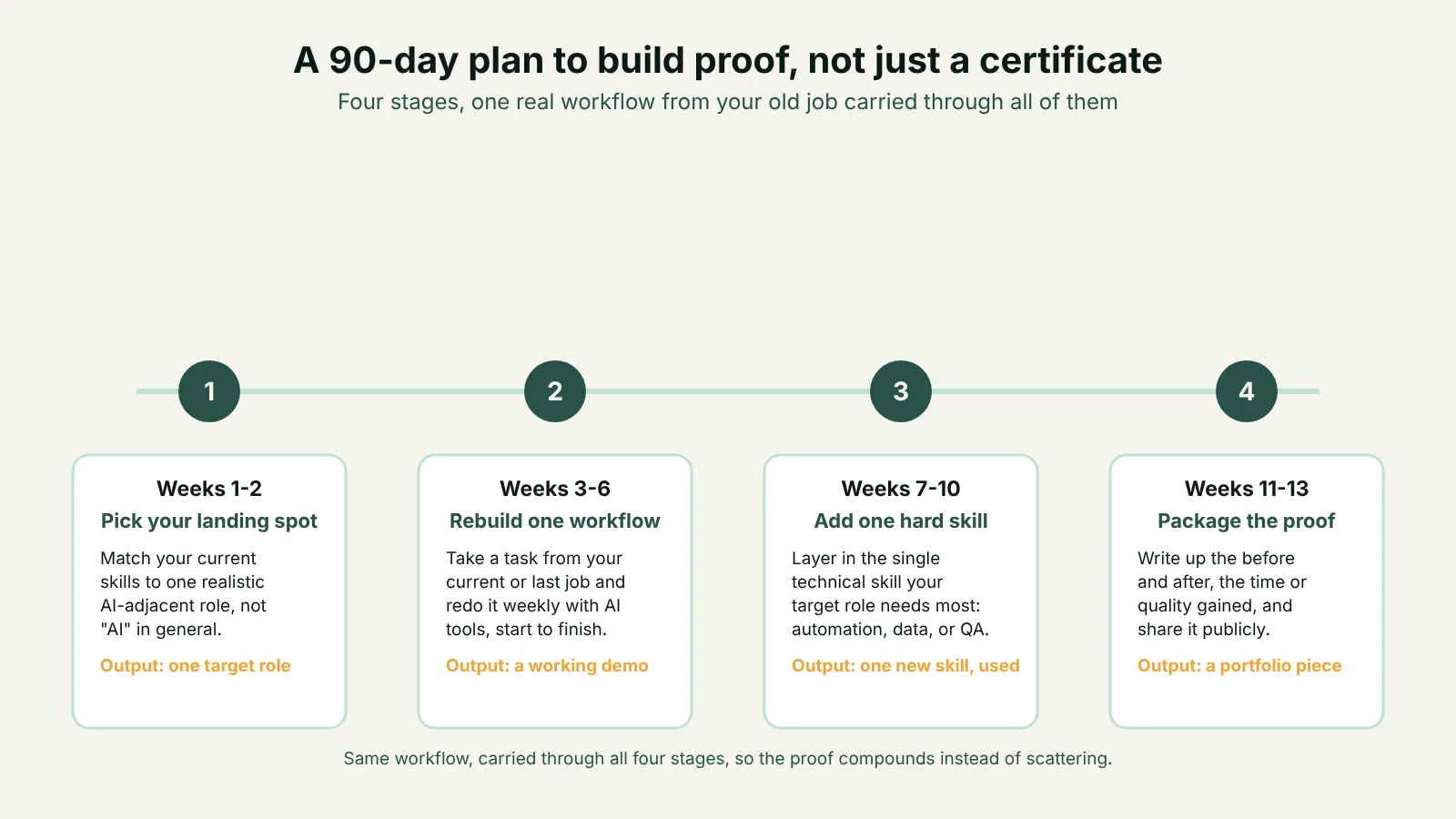
- Weeks 1 to 2: Pick one landing spot. Use the table above to choose a single realistic target, based on your current work, not your dream job. Write down the one workflow from your current or most recent role that this target role would touch.
- Weeks 3 to 6: Rebuild that one workflow with AI, every week. Don't try ten use cases. Take one recurring task, redo it with an AI tool each time it comes up, and keep notes on what worked, what failed and how long it actually took.
- Weeks 7 to 10: Add the one technical skill your target role needs most. For most of the four paths above, that is basic no-code automation or a simple evaluation checklist, not a programming language.
- Weeks 11 to 13: Package it as proof. Write a short, plain document: the task, the before, the after, the time or quality difference, and what you would do differently. Share it with your network or a hiring manager directly.
A short checklist before you call it done:
- The workflow is a real task you or a colleague actually did, not a toy example.
- You measured something concrete: time taken, error rate or output quality.
- You can explain in two sentences where the AI tool failed or needed a human check.
- You have one artifact (a document, a workflow screenshot, a short write-up) you can actually show someone.
Common mistakes that slow career changers down
- Learning tools instead of judgment. Tools change every few months. The ability to break a task down, give a model good context, and check its output is what actually lasts.
- Aiming at the most competitive role first. "AI engineer" is the most searched title and the most crowded. The four landing spots above are less obvious and less contested.
- Skipping verification. An employer trusts someone who catches AI's mistakes far more than someone who simply produces AI output.
- Treating a certificate as the finish line. A certificate shows you studied. A documented project shows you can do the job.
- Ignoring the hiring data for your field. If AI adoption in your target sector is still low, as it is in accounting for now, plan for a longer runway and look for the earliest-moving part of that sector.
How to go deeper
Everything above is learnable on your own with free tools and discipline. Where structured programs add value is in three places you can't easily get alone: live feedback on work you actually produce, a reviewed portfolio project instead of a self-graded one, and a certificate an employer can verify, rather than a screenshot of a completed course.
The AI Generalist Certification at Indus AI Academy is built for exactly the kind of career changer described in this guide: no coding background required, four weeks of live online sessions covering prompting, automation, building simple AI agents and shipping a small app, ending in a capstone project reviewed by faculty and a certificate issued by INDUS AI Private Limited. The next cohort is open for enrollment now.
If you want a lower-cost way to start building the habit before committing to a live program, our checklist for choosing an AI course will help you avoid courses that teach tool tours instead of real skills. And if you are further into your career rather than changing it, our guide for mid-career professionals covers a closely related path.
Frequently asked questions
Can I switch careers into AI without a computer science degree?
Yes, for most of the roles described in this guide. LinkedIn's research found that organizations hiring on demonstrated skills rather than degrees built AI talent pipelines 8.2 times larger, and cited US Bureau of Labor Statistics projections that 60% of new jobs by 2030 will not typically require a four-year degree (LinkedIn, January 2026). A computer science degree matters much more for roles like machine-learning engineering than for AI-adjacent operations, governance or support roles.
How long does it take to switch careers into AI?
There is no fixed timeline, and anyone who promises one is guessing. The 90-day plan in this guide is designed to produce a documented, checkable project in that time, which is a realistic milestone. Getting hired after that depends on your sector's hiring pace, your network and the specific role, none of which any article can promise you.
Do I need to learn to code to work in AI?
Not for most of the roles covered here. AI governance, AI-assisted operations, AI adoption leadership and AI-assisted marketing and support roles rely far more on judgment, communication and workflow design than on writing code. Coding becomes important if you specifically aim at machine-learning engineering or AI infrastructure roles.
Which skill should a career changer learn first?
Start with structured prompting and basic verification: writing clear, reusable instructions for an AI tool, and building a habit of checking its output against a source or a known-correct answer. These two skills apply across every AI-adjacent role and are the foundation everything else builds on.
Which industries are hiring the most for AI skills right now?
Based on Indeed's late-2025 data, data and analytics (around 45% of postings mention AI), software development, IT systems, and scientific research and development (20% or more) show the highest shares. Marketing and human resources are growing fast off a smaller base, while accounting remains low at around 6% (Indeed Hiring Lab, January 2026). These shares change quickly, so check current postings in your target sector before committing to a plan.
Found this useful?
Next cohort starts 1 Dec
AI Generalist Certification
Become the person on your team who gets things done with AI.
- Tuesdays, Thursdays and Saturdays, 7–9 PM IST
- 4 weeks · 12 sessions · 24 live hours · Online
- For: Professionals, managers, founders and career switchers
- ₹24,999 per seat, taxes extra
About the author
Vivek Gupta · IIT Delhi alumnus
Vivek Gupta is an IIT Delhi alumnus and PhD scholar, an AI researcher and serial entrepreneur with 14 years of building technology at MakeMyTrip, Goibibo, Wissen and Jubilant FoodWorks.
Discussion
No comments yet. Start the discussion.