AI Skills for Managers: What to Learn and How to Start in 2026
What AI skills for managers actually matter? Only 8% of HR leaders trust managers today, CEOs expect AI agents everywhere. Four skills, and how to start.

Vivek Gupta · IIT Delhi alumnus
· 11 min read

Most managers did not sign up to run a team that includes AI agents, yet a growing number already do. The honest answer, when you ask what AI skills for managers actually matter, is not a tool tutorial. It is a short, specific list of judgment calls: knowing what today's AI can and cannot do, deciding what to hand off and what to check, redesigning how work actually flows, and keeping a team's trust while all of that changes under them.
That list matters because the gap between expectation and readiness is wide and well documented. CEOs are planning for AI agents to be part of the org chart. Most managers say they are not ready to lead that, and most companies are not yet training them to be. This guide walks through what the research actually shows, the four AI skills worth building in order, and a realistic way to start this month, wherever you work.
Key takeaways
- CEOs are moving faster than managers are being prepared. 72% of CEOs surveyed by IDC expect they and their employees to have AI agents "reporting" to them within five years, but only 18-19% of those CEOs rank staff skillsets as a top factor in making that work.
- HR leaders see the gap clearly. A 2025 Gartner survey found only 8% of HR leaders believe their managers currently have the skills to use AI effectively, and only 14% of organizations actively support managers in using generative AI day to day.
- Experience builds confidence faster than training does. Among managers already leading AI-skilled employees, nearly 9 in 10 feel equipped, versus 45% of managers overall, according to Indeed and YouGov's research.
- The skills are mostly judgment, not code. Delegating the right task to AI, checking its output, redesigning a workflow and leading people through the change matter more than prompt syntax.
- Executives and employees disagree on readiness. 77% of executives think their managers are prepared to guide AI adoption; 91% of individual contributors disagree, per a 2026 Acorn report.
The gap nobody is pricing in
Start with what CEOs are actually planning for. In September 2025, IDC surveyed 155 CEOs in the United States and Canada, sponsored by Salesforce, for a report called Voice of the CEO on Digital Labor. Treat the detail with the usual caution for a vendor-sponsored, North America-only sample, but the direction is hard to miss: 72% of CEOs predict that they and their employees will have AI agents reporting to them within five years, 73% agree digital labor will transform their organizational structure, and CEOs who feel "fully prepared" for this are more than twice as likely as less-prepared peers to rank ethics and governance as critical to success. Strikingly, "staff skillsets" ranks near the bottom of the list of success factors CEOs name, at 18-19%, well behind technology infrastructure and use-case selection. CEOs are investing in the technology faster than in the people who will run it day to day.
That mismatch shows up directly in how managers rate themselves. A Gartner survey of 114 HR leaders, reported in October 2025 (People Matters; IT Brief), found that only 8% of HR leaders believe their managers currently have the skills to use AI effectively, and only 14% of organizations offer managers active support in bringing generative AI into their daily work. One in three HR leaders said their organizations already expect higher performance from employees who use AI, whether or not managers know how to guide that.
A separate, more recent data point adds nuance rather than contradicting this. Indeed and YouGov's 2026 survey, reported by Reworked, found 45% of managers say they feel ready to lead people hired for AI-native skills, but only 13% strongly agree they are equipped, and nearly half of employers say direct reports now have stronger AI skills than their managers do. The same research found something more useful than a gloomy headline: among managers who already lead AI-skilled employees, close to 9 in 10 feel equipped, compared with 45% of managers overall. Readiness jumps once a manager has actually done the work, not once they have sat through a slide deck. A 2026 Acorn report covering more than 1,200 executives and employees across the US, Canada and Australia found the same split from a different angle: 77% of executives believe their managers are prepared to guide AI skills development, but 91% of individual contributors disagree, and 34% of companies have not even defined what an "AI-skilled" manager looks like at the role level.
Put together, the picture is not "AI will replace managers." It is that most managers are being asked to lead a hybrid human-AI team without having been taught how, and most organizations know it.
What "AI skills for managers" actually means
The useful skill here is rarely technical. SHRM's guidance on managing hybrid human-AI teams is blunt about this: most leadership development was built for all-human teams, and managers don't need to become AI engineers to lead well. What they need is to know when to trust an AI-generated recommendation, when to override it, and who stays accountable when AI is involved in a decision.
One distinction worth learning early: a chatbot waits for your instruction at every step; an agentic AI system can plan and carry out a multi-step task with little supervision once you set it running, for example drafting a report, sending follow-up emails or updating records on its own. A manager who cannot tell the two apart risks two opposite mistakes: trusting an agent's multi-step output the way you would trust a single chatbot reply, or refusing to use an agent at all because it looks no different from the chatbots your team already treats with healthy skepticism.
A useful way to think about the skill itself comes from how people already describe managing AI agents directly. Writing in Built In, Saurabh Sharma frames the emerging skill as acting like an "AI manager": deciding which tasks suit which AI tool, judging output quality against domain expertise rather than just checking for obvious errors, and sequencing multi-step work across more than one AI system so that errors do not compound silently from one step to the next. That framing lines up with the IDC finding above: it is the same 72% figure, read from the worker's side of the desk instead of the CEO's.
The four AI skills every manager needs
Pulling the research together, four skills show up again and again, and they build on each other in a specific order. Skip the base and the higher layers have nothing to stand on; skip the top and you have a manager who can automate tasks but loses the team's trust while doing it.
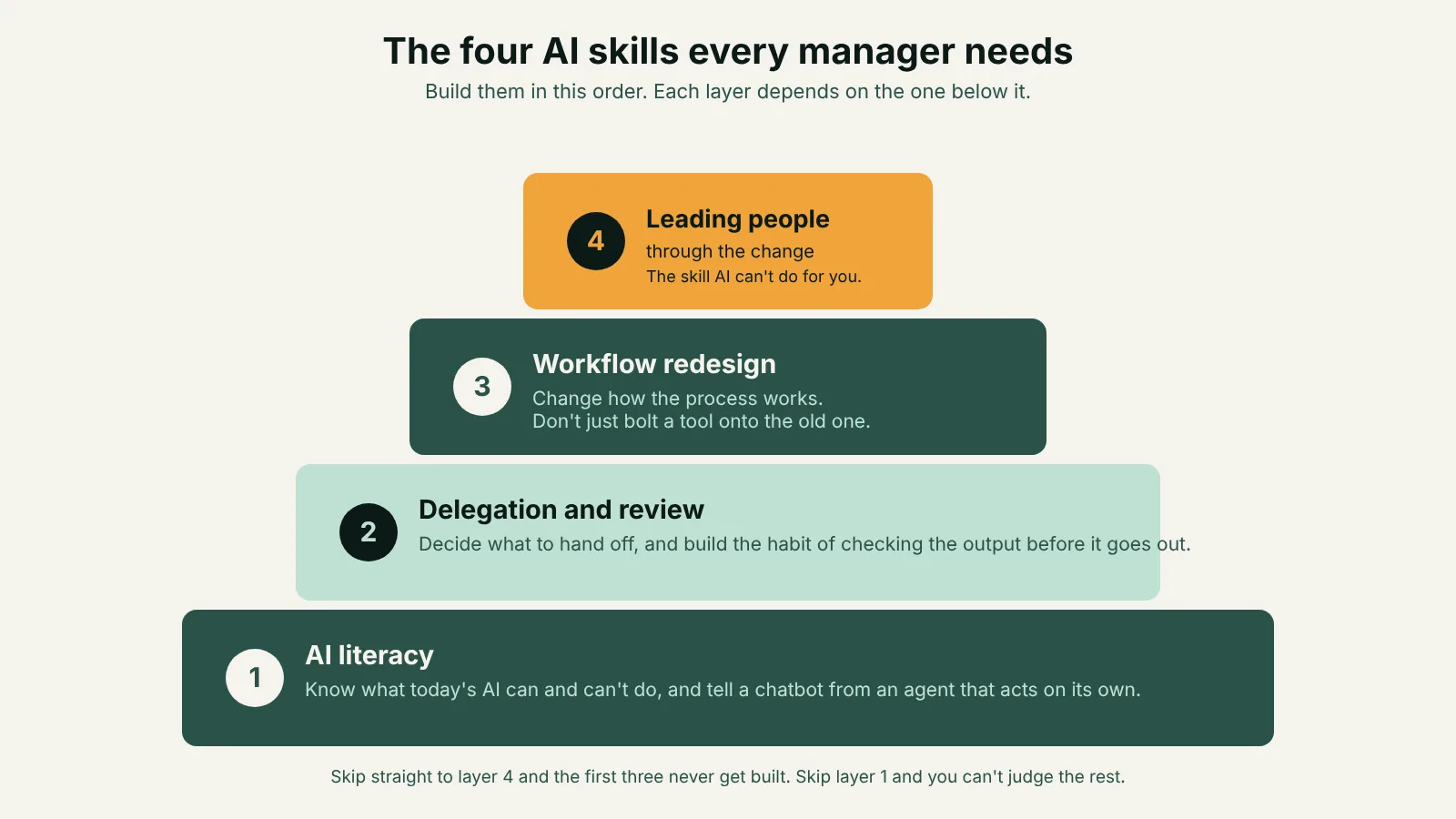
- AI literacy. Knowing, in plain terms, what current AI tools are actually good at (drafting, summarizing, finding patterns in data, handling repetitive multi-step tasks) and where they still fail (facts they cannot verify, judgment calls with real stakes, anything that needs full context they were not given). This includes the chatbot-versus-agent distinction above.
- Delegation and review. Deciding which parts of a workflow are safe to hand to AI and which need a person, then building an actual habit of checking output before it goes out the door, the same way you would review a junior employee's first few weeks of work.
- Workflow redesign. The weakest version of "using AI" is bolting a chatbot onto an unchanged process. The useful version is asking which steps of a recurring workflow can be reordered, combined or removed entirely once AI handles the repetitive parts, so the human steps left over are the ones that need a human.
- Leading people through the change. This is the layer research keeps circling back to, and the one no AI tool can do for a manager. It means being honest with a team about what is changing and what is not, protecting people's sense of security while roles shift, and making clear which decisions still require a person's sign-off.
| Skill | What it replaces | A concrete first step |
|---|---|---|
| AI literacy | Vague confidence or vague fear | Run the same real task through an AI tool twice this week, and write down exactly where it helped and where it was wrong |
| Delegation and review | "I'll just use it for everything" or "I don't trust it for anything" | Pick one recurring task on your team and write a one-line rule for what AI may draft versus what a person must still approve |
| Workflow redesign | Automating a bad process faster | Map one weekly workflow end to end before touching any tool, then ask which steps disappear, not just which steps speed up |
| Leading people | Silence, or a one-off all-hands announcement | Tell your team directly what is and is not changing in how their work is reviewed, and keep saying it as things actually change |
How to build these skills this month
None of this requires a budget, and none of it requires waiting for a formal course to start.
- Use AI on your own work first, for two straight weeks. Pick three tasks you already do (drafting updates, summarizing documents, preparing a report) and run them through a general AI assistant before you do them yourself. Keep a short log of where it saved real time and where you had to fix something it got wrong. This single habit is what separates the "9 in 10 feel equipped" managers in the Indeed/YouGov research from the rest: direct, repeated use beats a one-time training session.
- Pick one team workflow to redesign, not automate. Choose something your team does every week, map every step on paper, and ask which steps can be cut or combined once AI handles the repetitive middle. Resist the urge to just add an AI step to the process you already have.
- Write down one review rule and share it. A single sentence like "AI can draft the first version of client emails; a person reviews before sending" does more for a team's trust than a long policy document nobody reads.
- Talk to your team about it before they ask. The research above is consistent on this point: employees usually notice the skills gap, and the trust gap, before their manager does. A short, honest conversation about what is changing closes more of that gap than any tool rollout.
- Find one peer doing this well and ask how. Gartner's own recommendation to HR leaders is almost identical: combine hands-on practice with peer-to-peer sharing, not formal training alone.
How to go deeper
This guide gets you through the first month on your own. Leading a team through a longer AI transition, with real organizational change, vendor decisions and governance questions attached, is a different scale of problem, and that is where structured help pays off. Indus AI Academy's AI for Leaders program is built for exactly this: live sessions you can join from anywhere, working sessions where you build an AI opportunity map, a vendor evaluation scorecard and a governance checklist for your own team rather than a generic one, and a certificate of completion from Indus AI Academy at the end.
If you want the fuller picture of how AI is reshaping roles more broadly before deciding where to focus, our guide to what an AI generalist actually does and the global hiring data in AI and the future of jobs are good next reads. If you are weighing a bigger move into an AI-focused role yourself rather than just leading a team through one, see how to switch careers into AI.
Frequently asked questions
Do managers need to learn to code to use AI well?
No. Every source in this guide, from SHRM to Gartner to Built In, frames the core manager skill as judgment: knowing what to delegate, how to check output, and when to involve a person. Coding is a separate, optional skill that mainly matters if you want to build or customize AI tools yourself, not to lead a team that uses them.
What is the difference between a chatbot and an AI agent, and why does it matter for a manager?
A chatbot responds to one instruction at a time and waits for your next input. An agentic AI system can carry out a multi-step task on its own once you set it running, such as researching a topic, drafting a document and sending it, with little or no supervision in between. Managers who cannot tell the two apart tend to either over-trust multi-step agent output or under-use agents because they look, at a glance, like the chatbots their teams already use carefully.
Will AI replace managers?
The research here points to role change rather than replacement. IDC's survey of CEOs found most expect digital labor to take on more strategic work, not just routine tasks, and expect four in five workers to either stay in their current roles or be redeployed rather than lose their jobs. What is changing is what managers are expected to be good at: less time spent compiling status updates, more time spent reviewing AI-assisted output and coaching people through a changing workflow.
How long does it take to build real AI literacy as a manager?
There is no fixed number, but the research offers a useful signal: managers who already lead AI-skilled employees report far higher confidence (close to 9 in 10 feel equipped) than managers who have not yet had hands-on exposure (45% overall). That gap closes with weeks of direct, regular use on real tasks, not with a single workshop. A realistic first checkpoint is one month of deliberate practice on your own work before you start redesigning a team workflow.
What is the first AI skill a manager should build?
Start with AI literacy on your own real tasks before touching your team's workflows. You cannot judge what to delegate, what to check, or how to redesign a process until you have a working sense of where AI genuinely helps and where it confidently gets things wrong.
Found this useful?
Next cohort starts 1 Dec
AI Generalist Certification
Become the person on your team who gets things done with AI.
- Tuesdays, Thursdays and Saturdays, 7–9 PM IST
- 4 weeks · 12 sessions · 24 live hours · Online
- For: Professionals, managers, founders and career switchers
- ₹24,999 per seat, taxes extra
Related
AI for Leaders
About the author
Vivek Gupta · IIT Delhi alumnus
Vivek Gupta is an IIT Delhi alumnus and PhD scholar, an AI researcher and serial entrepreneur with 14 years of building technology at MakeMyTrip, Goibibo, Wissen and Jubilant FoodWorks.
Discussion
No comments yet. Start the discussion.