How Small Business Owners Can Learn AI Without Wasting Time or Money
Most owners already use AI but don't trust their own skills with it. A practical, step-by-step way for small business owners to learn AI that sticks.

Vivek Gupta · IIT Delhi alumnus
· 11 min read

Ask small business owners anywhere whether they use AI, and most will say yes. Ask whether they trust their own skills using it, and the answer changes fast. In the United States, 87% of small businesses now use at least one AI tool, but only 20% rate their own effective use highly on a 10-point scale, according to Bluehost's 2026 State of Small Business AI Confidence survey. That gap between using AI and using it well is the real problem for a small business owner to solve, and a better tool will not close it. Learning the skill properly will.
This guide is for small business owners, freelancers and solo founders anywhere who want to close that gap: what the evidence shows about how owners are learning AI today, where that self-taught approach runs out of road, and a structured way to learn AI as a small business owner that compounds instead of resetting every time a new tool launches.
Key takeaways
- Usage has outrun confidence. 87% of small businesses use at least one AI tool, but only 20% rate their own effective use highly, per Bluehost.
- Most owners are teaching themselves from scattered sources. 57% of small business decision-makers rely mainly on YouTube and social media to learn AI, and a third ask the AI tool itself how to use it, per Thryv's 2026 survey.
- The barrier usually isn't cost. Intuit's 2026 AI Impact Report, covering the US, Canada, UK and Australia, found privacy and security worries, fear of errors, and uncertainty about what AI can do rank above cost as the top barriers.
- This is a global pattern, not a developed-market quirk. The OECD's Digital Economy and Society Outlook 2026 puts overall AI use across OECD economies at 20% of firms, versus 52% for large firms, and links the gap to a lack of in-house skills, as reported by HRD/HCAMag.
- Structured practice beats scattered tips. Owners who already pay for AI tools report higher confidence than free-only users, and growth-focused businesses are far more likely to invest in using AI well, per Intuit.
Why so many small business owners feel behind on AI
The data is consistent across very different surveys: adoption has moved fast, confidence has not kept up. Intuit's report, built from more than 34,000 small and midsize business owner surveys and anonymized transaction data from 5.3 million QuickBooks businesses, found that 77% of US small businesses now use AI regularly, up from 48% in mid-2024, and 78% say it improved their productivity. Goldman Sachs' survey of its small business education network, fielded in January and February 2026 with 1,256 respondents, found more than three-quarters of owners use AI to some degree and over 90% say it is working for them — yet only 14% have embedded it across their core operations, and more than 70% say they would benefit from more training and implementation support.
Thryv's April 2026 survey of 561 US small and midsize business decision-makers tells a similar story from a different angle: 66% use AI, up from 55% a year earlier, but 70% still say they need more training to use it effectively, even though 86% describe themselves as comfortable using it. Comfortable and effective are not the same thing, and that gap is exactly where most owners are stuck.
What's notable is what isn't the main barrier. Intuit's report found cost ranks below privacy and security concerns, fear of making an error, and simply not knowing what AI can reliably do. That matters because it means the fix isn't a cheaper tool — it's a clearer sense of what to trust AI with and what to check yourself.
What AI is actually good for in a small business
Before learning any AI skill, it helps to know where it already pays off, according to the data rather than marketing claims. Intuit's analysis found adoption is highest in three areas, and lowest where judgment matters most:
- Marketing content. Social posts, product descriptions and promotional copy, where a first draft saves real time even after editing.
- Administrative work. Scheduling, replying to routine emails, and drafting documents you'd otherwise write from scratch.
- Customer communication. Answering common questions quickly, in your own tone, especially outside business hours.
- Light data work. Summarizing a spreadsheet export or spotting a pattern in your own sales or expense data, with you checking the output before acting on it.
Adoption drops sharply for tasks that need real judgment: pricing decisions, hiring, anything with legal or financial consequences. That's not a limitation to work around — it's the line a small business owner should draw deliberately, not stumble into.
How small business owners are learning AI today — and where it falls short
Thryv's survey is the clearest picture of how owners are actually picking this up: 57% rely mainly on YouTube and social media, 49% use online resources and webinars, and a third ask an AI chatbot itself how to use AI tools. None of this is a bad starting point. The problem is what it leaves out.
| Learning channel | What it's good for | What it misses |
|---|---|---|
| YouTube and social media | Quick tips, seeing a tool in action fast | No feedback on your own business, easy to pick up habits that don't fit your situation |
| Asking the AI tool itself | Explaining its own features on demand | Can't tell you when you gave it bad context, or when a safer approach exists |
| Trial and error on live customer work | Free, immediate | Mistakes land on real customers and real data; no one checks your blind spots |
| A structured path with practice and feedback | Skills build on each other in order, feedback on your own real workflow | Needs a real time commitment, and usually some cost |
This is why 70% of Thryv's respondents say they still need more training despite already being "comfortable" with AI: comfort from scattered tips doesn't compound the way a deliberate, ordered set of skills does. Each new tool resets you back to square one instead of building on what you already learned.
A step-by-step way to learn AI as a small business owner
You don't need a formal course to start, and you don't need a budget either. What you need is a structure, so that each week builds on the last instead of starting over with a new tool. Here's a realistic four-week version:
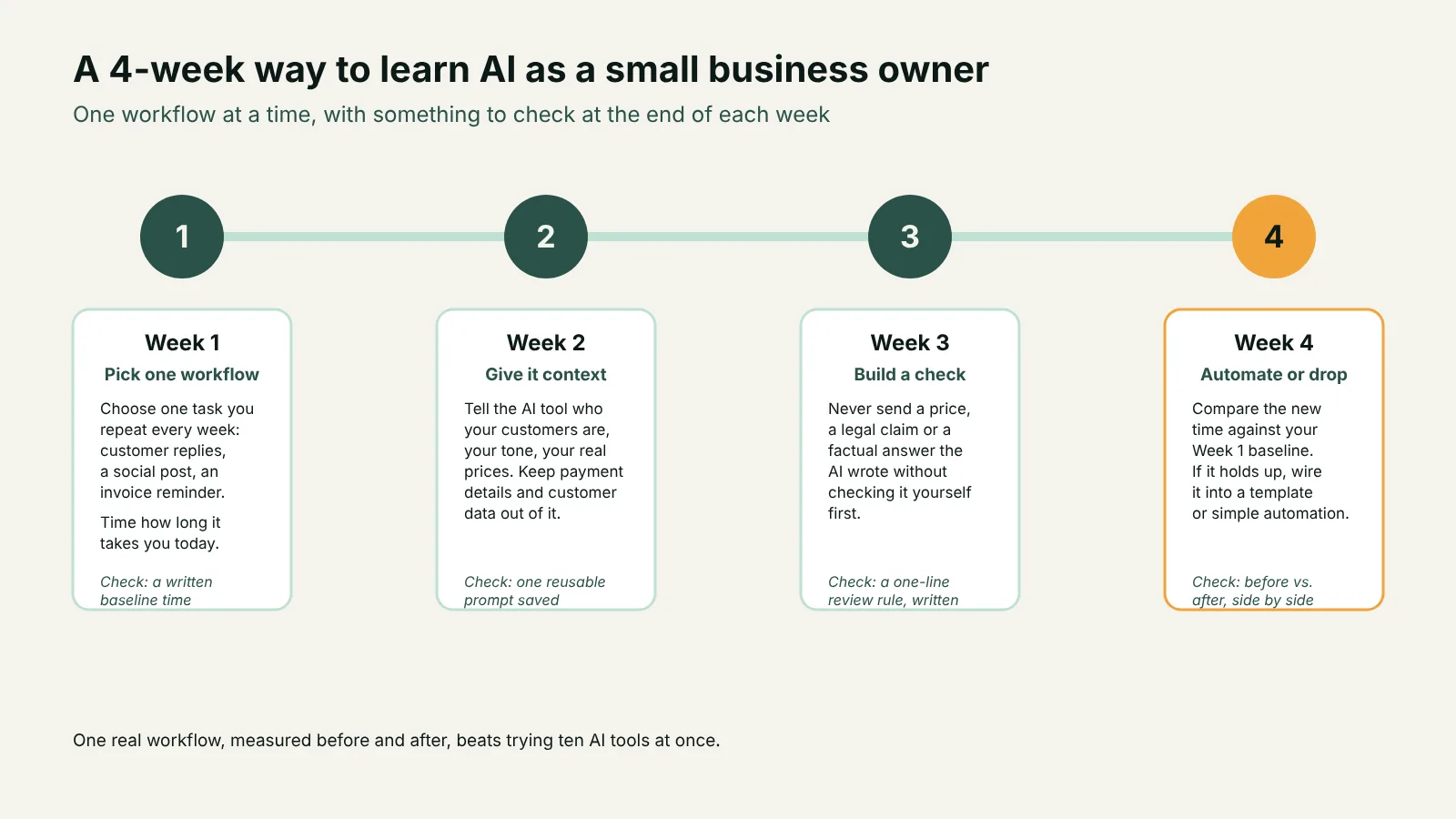
- Week 1 — Pick one workflow. Choose a single task you repeat every week: replying to a common customer question, writing a social post, drafting an invoice reminder. Time how long it takes you today, by hand. That number is your baseline, and without it you can't tell later whether AI actually helped.
- Week 2 — Give it context, carefully. Tell the AI tool who your customers are, what tone you use, and your real prices or policies. The more specific the context, the more useful the draft. Keep payment details, customer personal data and anything confidential out of what you paste in, and check your tool's own privacy settings first.
- Week 3 — Build a checking habit. Never send a price, a legal claim, or a factual statement an AI tool generated without checking it yourself against a real source. This single habit is what separates effective use from the 76% of paying users in Bluehost's survey who still don't feel confident in their own output.
- Week 4 — Compare, then automate or drop it. Measure the new time against your Week 1 baseline. If it genuinely holds up on real work, turn it into a saved template or a simple automation. If it doesn't save real time or introduces errors you have to fix anyway, drop it and try a different workflow next month.
Repeat this cycle with a new workflow each month, and skills accumulate instead of resetting. This is also the structure behind our guide on what an AI generalist actually does — the same ordered skill-building, applied to a business of one or a handful of people instead of a large team.
The skills gap is global, not just a developed-market problem
It's tempting to read all this as a US phenomenon, since most of the large surveys are American. The OECD's newest data says otherwise. Its Digital Economy and Society Outlook 2026 found AI use at roughly 20% of enterprises across OECD economies overall, compared with 52% for large firms — and warned the gap could widen further this decade without targeted support, citing limited finance, infrastructure and specialized skills as the main reasons smaller businesses fall behind. The OECD's companion work on SMEs specifically points to a lack of in-house expertise, not a lack of available tools, as the binding constraint — and calls for skills development alongside clearer legal frameworks and support for integration costs.
In other words, this isn't about which country has better access to AI tools. Almost every tool mentioned in this article is available globally, often for free. The gap is in structured skill-building, and it shows up everywhere small businesses operate — from a solo consultant in Toronto to a retail shop in Lagos to a family business in Mumbai.
What a month of real practice looks like
Treat the following as what survey respondents reported about their own businesses, not a guarantee about yours — results vary by business, industry and how carefully AI output gets checked. Thryv's respondents who use AI reported real outcomes worth knowing about: 92% said it saves them time, with 79% expecting to recover between 11 and 60 hours a month; 70% said AI contributed to increased revenue over the past year; and 55% said it reduced costs. Intuit's data adds a useful nuance: 86% of businesses that paid for AI tools in 2024 were still paying a year later, and growth-focused businesses were more than twice as likely to pay for dedicated AI tools than businesses focused on stability. Owners who invest in actually learning the tools, not just trying them once, are the ones who keep using them.
A short checklist before you call a workflow "done":
- You have a written baseline (time or cost) from before you used AI on this task.
- You've told the tool who your customers are and what tone you use, without sharing sensitive data.
- You have a one-line rule for what the AI may draft versus what you personally check before it goes out.
- You've compared the after-result against your baseline on at least five real instances, not one lucky try.
- You know exactly what this workflow should never be trusted to decide on its own (pricing, legal claims, anything with real consequences).
How to go deeper
A month of deliberate practice on your own workflows, as above, gets you real skill with no cost beyond your time. If you want that skill-building structured, with feedback from someone other than the AI tool itself, Indus AI Academy's AI Generalist Certification is built for exactly this kind of learner: founders and career switchers alongside working professionals, live online sessions you can join from anywhere, a capstone project built on a real problem from your own work, and a verifiable certificate at the end. The next cohort is open for enrollment now.
If you're running a business in India specifically and want tools and rules that apply there, our companion guide on AI for small business owners in India and our broader look at AI agents for business are good next reads once this month's practice is done.
Frequently asked questions
How much does it cost to learn AI as a small business owner?
Learning the skill itself costs nothing beyond your time: most mainstream AI chatbots offer a usable free tier, and the four-week plan above needs no paid tools. Costs start to appear once you move past free limits on a specific tool, or choose to invest in structured, feedback-driven learning rather than teaching yourself from scattered videos.
Is AI worth it for a very small business or a solo freelancer?
The evidence suggests it can be, but results vary and aren't guaranteed. Intuit's data found 86% of businesses that paid for AI tools in 2024 were still paying a year later, and growth-focused businesses invest in it at more than twice the rate of stability-focused ones. Treat any revenue or time-savings figure you read, including the ones in this article, as a self-reported survey result for other businesses, not a promise for yours.
What's the biggest mistake small business owners make when learning AI?
Treating it as a tool to try once rather than a skill to build deliberately. Thryv's survey found 70% of owners still want more training despite most already calling themselves "comfortable," which points to scattered exposure rather than structured practice. A related mistake is on data: the OECD found 46% of surveyed SMEs have no or only minimal digital security measures in place, which matters more once you start feeding AI tools real business information.
Do I need to learn to code to use AI well in my business?
No. Nearly all of the adoption described in this guide, across marketing, admin, customer replies and light data work, happens through everyday chat-based AI tools, not code. The skill that matters is giving a tool clear context about your business and checking its output, not programming.
How long before I see results from learning AI properly?
There's no fixed number, and no source in this guide promises one. The four-week structure above is designed to give you a real before-and-after comparison on one workflow within a month, which is enough to judge whether it's worth repeating with a second workflow. Thryv's respondents who already use AI report recovering time within a typical month, but that's a survey result about other businesses, not a timeline guaranteed for yours.
Found this useful?
Next cohort starts 1 Dec
AI Generalist Certification
Become the person on your team who gets things done with AI.
- Tuesdays, Thursdays and Saturdays, 7–9 PM IST
- 4 weeks · 12 sessions · 24 live hours · Online
- For: Professionals, managers, founders and career switchers
- ₹24,999 per seat, taxes extra
About the author
Vivek Gupta · IIT Delhi alumnus
Vivek Gupta is an IIT Delhi alumnus and PhD scholar, an AI researcher and serial entrepreneur with 14 years of building technology at MakeMyTrip, Goibibo, Wissen and Jubilant FoodWorks.
Discussion
No comments yet. Start the discussion.