The Jobs AI Can't Replace Aren't the Ones You Think
PwC analyzed over a billion job postings and found AI splitting work into two tracks. Here's what decides which track your job is on, and how to move up.

Vivek Gupta · IIT Delhi alumnus
· 12 min read

Search "jobs AI can't replace" and you'll get lists: nurses, electricians, teachers, therapists, hairdressers. These lists aren't wrong, exactly, but they answer a question that matters less than it used to. PwC's 2026 Global AI Jobs Barometer, built from more than a billion job postings across six continents, found something more useful than a list of safe professions: AI isn't mainly eliminating whole jobs. It's splitting almost every profession into two tracks — one where AI makes your judgement more valuable, and one where it makes your judgement less necessary. Which track your specific role is on matters far more than its job title.
This matters wherever you're reading from. A recruiter in Lagos, a radiologist in Manila, a support lead in São Paulo and a marketing manager in Toronto are all being pulled onto one of these two tracks right now, often without anyone at their company naming it. This article lays out the evidence, and what to actually do about it.
Key takeaways
- The real split isn't "safe jobs vs. doomed jobs." PwC's analysis of over a billion job postings found AI sorting work into a "professionalised" track (22% of jobs, where human expertise becomes more valuable) and a "democratised" track (52%, where AI lowers the skill needed, so the role stops commanding a premium).
- Professionalised roles are pulling ahead: roughly twice the hiring growth of democratised roles, and pay growing about 42% faster.
- Entry-level work isn't vanishing — it's reshaping. AI-exposed junior roles are seven times more likely to demand senior skills like leadership and judgement, and these "seniorised" entry roles grew 35% since 2019 while other entry-level postings shrank.
- Where you live still changes your exposure a lot. Roughly 60% of jobs in high-income countries are AI-exposed, versus about 26% in low-income countries — but the ILO and World Bank warn developing economies risk disruption arriving before the gains do.
- No large wave of job losses has shown up yet. Anthropic's labour-market research finds no systematic rise in unemployment among highly AI-exposed workers so far, though hiring of young workers into those occupations has slowed.
Why "jobs AI can't replace" is the wrong question
Most "jobs AI can't replace" articles score whole professions as safe or unsafe. Real jobs are bundles of dozens of different tasks, and generative AI's reach runs through tasks, not titles. The International Labour Organization's refined Global Index of Occupational Exposure, which scored nearly 30,000 individual tasks, found that globally about one in four workers are in a role with some exposure to generative AI. It also found something easy to miss: exposure scores have become less concentrated since 2023, not more — the mean automation score barely moved (0.29 in 2025, versus 0.30 in 2023), while the spread across occupations narrowed. AI isn't settling on a short list of doomed professions; it's spreading thinly across almost every one.
That's why PwC's "two-track" framing is more useful than a list. It doesn't ask whether your profession survives. It asks what AI is doing to the tasks inside your role, and whether that leaves your remaining work more valuable or less.
The two-track labour market, in PwC's own numbers
PwC's 2026 Global AI Jobs Barometer is one of the largest labour-market studies built this year, drawing on over a billion job advertisements across six continents. Its central finding is a split into two groups of roles:
- Professionalised roles (22% of advertised jobs): AI automates the routine parts of the job, and the humans who remain handle more judgement-heavy, expert work. PwC's examples are radiologists (AI flags anomalies; the radiologist makes the call) and recruiters (AI screens résumés; the recruiter negotiates and builds trust). These roles are growing in job numbers roughly twice as fast as democratised roles, and average pay has grown about 42% faster since 2021.
- Democratised roles (52% of advertised jobs): AI takes over enough of the complex work that the role needs less specialist skill to perform, so it stops commanding a premium. PwC's examples are inventory clerks and IT service and medical-secretary roles, where AI increasingly handles the harder parts of the job directly. These roles are growing more slowly, and pay is falling behind.
PwC's own framing is blunt: the returns go to organisations and workers who use AI to amplify expertise and create new value, not just to automate what already exists.
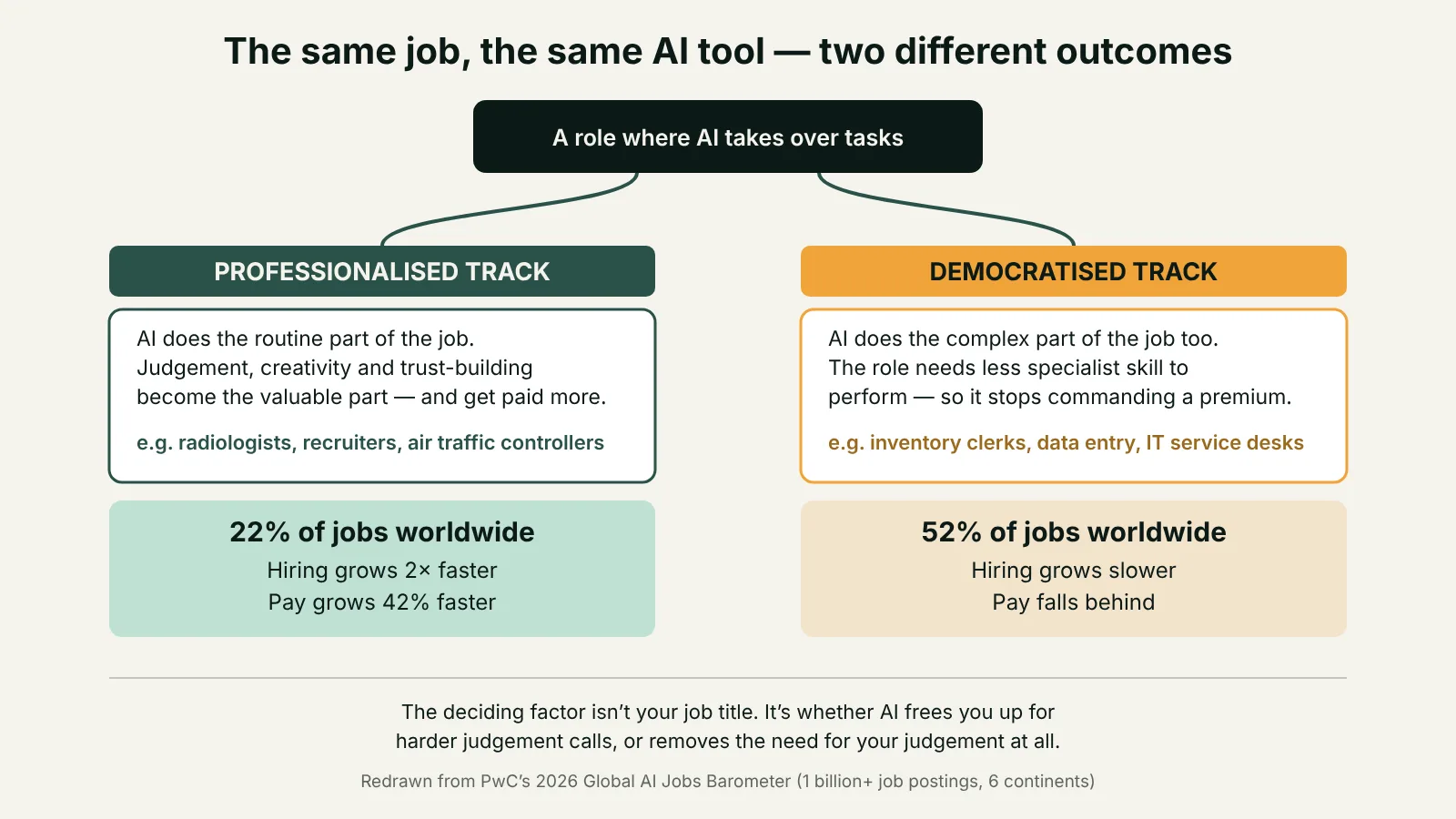
A detail that should reassure anyone reading a "safe jobs" list and not finding their profession on it: PwC notes that some roles widely assumed to be at risk — air traffic controllers and marketing managers among them — are seeing rising demand, rising wages and rising skill requirements, because the parts of those jobs that AI can't yet do (split-second accountability, brand judgement) are becoming the entire job.
What's actually driving the gap: skills, not luck
The two tracks aren't random. PwC's job-postings data shows the most AI-exposed occupations gaining new required skills at roughly twice the pace of the least-exposed ones, with around 433 distinct new skills appearing per occupation between 2019 and 2025, against 256 in the lowest-exposure quartile — a gap that widened by about 75% in the last year alone. The occupations absorbing AI fastest aren't standing still; they're the ones where the skill bar is rising fastest.
That matches what employers say they want. The World Economic Forum's Future of Jobs Report 2025, surveying over 1,000 employers representing more than 14 million workers across 55 economies, ranks "AI and big data" as the single fastest-growing skill category worldwide for 2025–2030, ahead of networks and cybersecurity and technological literacy. The same report expects 39% of workers' core skills to change by 2030 — down slightly from 44% in its 2023 edition, suggesting the first wave of reskilling is catching up a little with the pace of change, not that the change itself has slowed.
| Professionalised track | Democratised track | |
|---|---|---|
| What AI does | Handles routine, repeatable parts of the job | Handles routine and complex parts of the job |
| What's left for you | Judgement, negotiation, accountability, creative calls | Simpler supervision of what AI already decided |
| Share of jobs globally | About 22% | About 52% |
| Hiring trend | Roughly 2x faster growth | Slower growth |
| Pay trend | About 42% faster wage growth since 2021 | Falling behind |
| Example roles | Radiologists, recruiters, air traffic controllers | Inventory clerks, IT service desk staff, medical secretaries |
Source: PwC's 2026 Global AI Jobs Barometer.
The entry-level paradox
If you're early in your career, this data looks contradictory, and it's worth untangling because it affects how you should act.
Stanford's 2026 AI Index — one of the first major reports to use real hiring records rather than employer surveys — found that employment for software developers aged 22 to 25 has fallen nearly 20% since 2024, with a smaller decline for young workers in customer support. Most older age groups in the same occupations grew, which points at entry-level hiring specifically, not broad layoffs of experienced staff.
Anthropic's own labour-market research, published in March 2026, adds a careful read on the same pattern. Using a new "observed exposure" measure that blends what AI can theoretically do with how people actually use Claude, the authors found no systematic rise in unemployment among highly exposed workers since late 2022 — but hiring of young workers into highly AI-exposed occupations has fallen by around 14% relative to 2022, a result they call only barely significant. Separately, workers already in the most exposed occupations earn 47% more on average than those in the least-exposed ones — exposure, so far, correlates with skilled, well-paid work, not low-wage work.
PwC's postings data explains the mechanism. Analysing 2.4 million entry-level US job postings, it found AI-exposed junior roles are seven times more likely than other entry-level roles to ask for traditionally senior skills — leadership, client judgement, creative direction. Openings for these "seniorised" entry-level roles grew 35% since 2019, while other, more routine entry-level postings shrank by about 10%.
Put together, the honest picture isn't "AI is closing the door on juniors." It's that the door opening wider is a harder one than before — it expects judgement and initiative from day one, not just reliable execution of routine tasks. That rewards building toward it early, rather than waiting for a title to catch up.
Why your country still changes the picture
None of this falls evenly across the world. The European Training Foundation, an EU agency that tracks skills and labour markets, reports that around 60% of jobs in high-income countries carry some AI exposure, against roughly 26% in low-income countries — mainly because richer economies have far more office-based, cognitive-task jobs to begin with. Even then, only about 5% of jobs in high-income countries face a high risk of full automation; the ETF's own framing is that the most immediate effects show up in job quality, not headline employment numbers, in most countries so far.
The harder warning comes from a joint ILO–World Bank working paper, published in March 2026 for the World Bank's World Development Report 2026, covering 135 countries and roughly two-thirds of global employment. Its concern isn't that developing economies are more exposed — they're generally less exposed on paper. It's that many risk disruption before they see benefits: workers in automation-vulnerable roles, especially clerical jobs that have long been an entry point into formal work for women, are often already online and reachable by AI tools, even where broader digital infrastructure is weak. Exposed enough to be disrupted, not yet equipped to capture the upside — that combination is the real global fault line here, and a reason policy matters as much as individual effort in lower-income labour markets.
So which track are you actually on?
Forget your job title for a moment and ask three honest questions about the work you do today:
- When AI handles a task for you, does it hand you back time to do something harder, or does it just make the easy version of your job need less of you? The first is the professionalised pattern. The second is the democratised one.
- Is the judgement you provide becoming more visible to your employer, or more replaceable? Recruiters who now spend AI-freed time on negotiation and candidate trust are moving up the professionalised track. Staff whose entire remaining task is "check what the AI produced" are not.
- Are you building new, harder skills faster than your role is being automated, or slower? PwC's data says the gap between these two groups is widening by about 75% a year. Standing still is itself a move toward the democratised track.
If your honest answers point toward the democratised side, that is not a verdict on your profession. It's a signal about which parts of your current role to actively change, this quarter, not eventually.
How to move toward the professionalised track
Take over the judgement calls AI frees up, deliberately. Don't let saved time evaporate into more routine throughput. If AI cuts your research time in half, spend the other half on the part of your work that actually needs a human: checking output against a real case, building the relationship, making the call you'd be accountable for.
Build a visible skill, not just a faster workflow. The roles pulling ahead aren't just "AI users" — they're people who added a specific capability (negotiation, domain judgement, a portfolio of finished work) that AI didn't give them; it just gave them time to build it.
Practise on real problems, not just prompts. We've written before about what it takes to switch careers into AI and what distinguishes an effective AI generalist from someone merely comfortable with a chatbot: the difference is almost always a body of finished, checkable work, not a longer list of tools used.
If you manage people, redesign the role, not just the task. We covered this for AI skills for managers: the professionalised track isn't something that happens to individuals alone — it depends on whether your organisation redesigns jobs around higher-judgement work, or just layers AI on top of an unchanged role.
How to go deeper
The underlying reports repay reading directly: the WEF's Future of Jobs Report 2025 for the employer-survey view, and our earlier piece on AI and the future of jobs for the headline numbers on job creation and displacement by 2030, which this article deliberately didn't repeat.
If you want structured practice rather than reading alone, the next cohort of the AI Generalist Certification adds what reading can't: live sessions you can join from anywhere, feedback from faculty on your own real work, a portfolio capstone, and a certificate anyone can verify — exactly the kind of finished, checkable work that moves you toward the professionalised side of this data.
Frequently asked questions
Will AI replace my job?
Almost certainly not your whole job — most roles bundle many tasks, and AI handles some well and others poorly. The more useful question is whether AI frees you up for harder, more valuable work (the professionalised pattern) or takes over enough of your role that less skill is needed to do it (the democratised pattern). The ILO's own conclusion, based on scoring nearly 30,000 individual tasks, is that transformation is far more likely than outright elimination for most jobs.
What is the "two-track" AI job market?
It's PwC's term, from its 2026 Global AI Jobs Barometer, for a pattern found across a billion job postings: AI sorts roles into "professionalised" jobs (about 22% of postings, where it automates routine work and human expertise becomes more valuable and better paid) and "democratised" jobs (about 52%, where it lowers the skill needed to do the work, so pay and demand grow more slowly).
Which jobs are safest from AI?
There's no fully safe list, but the roles holding up best share a pattern: final accountability stays with a human, the stakes of a wrong call are high, and trust-building is a real part of the job. Air traffic control and radiology are PwC's own examples of roles where demand and pay are rising despite real AI involvement, because the irreducible human part of the job is what remains.
Do entry-level jobs disappear because of AI?
Not uniformly. Stanford's 2026 AI Index found a nearly 20% drop in software-development employment for workers aged 22–25 since 2024, and Anthropic's research found hiring into AI-exposed occupations has slowed for young workers. But PwC's postings data shows a different kind of entry-level role growing — ones demanding traditionally senior skills like judgement and leadership from day one, up 35% since 2019. Entry-level work is reshaping around higher expectations, not simply vanishing.
What skills should I build to stay on the right side of this split?
Build toward judgement, not just tool fluency: finished work you can show, domain knowledge AI can't substitute for, and the habit of using AI-freed time for harder calls rather than more routine throughput. A structured, assessed program can compress this into weeks of guided practice rather than months of trial and error.
Found this useful?
Next cohort starts 1 Dec
AI Generalist Certification
Become the person on your team who gets things done with AI.
- Tuesdays, Thursdays and Saturdays, 7–9 PM IST
- 4 weeks · 12 sessions · 24 live hours · Online
- For: Professionals, managers, founders and career switchers
- ₹24,999 per seat, taxes extra
About the author
Vivek Gupta · IIT Delhi alumnus
Vivek Gupta is an IIT Delhi alumnus and PhD scholar, an AI researcher and serial entrepreneur with 14 years of building technology at MakeMyTrip, Goibibo, Wissen and Jubilant FoodWorks.
Discussion
No comments yet. Start the discussion.